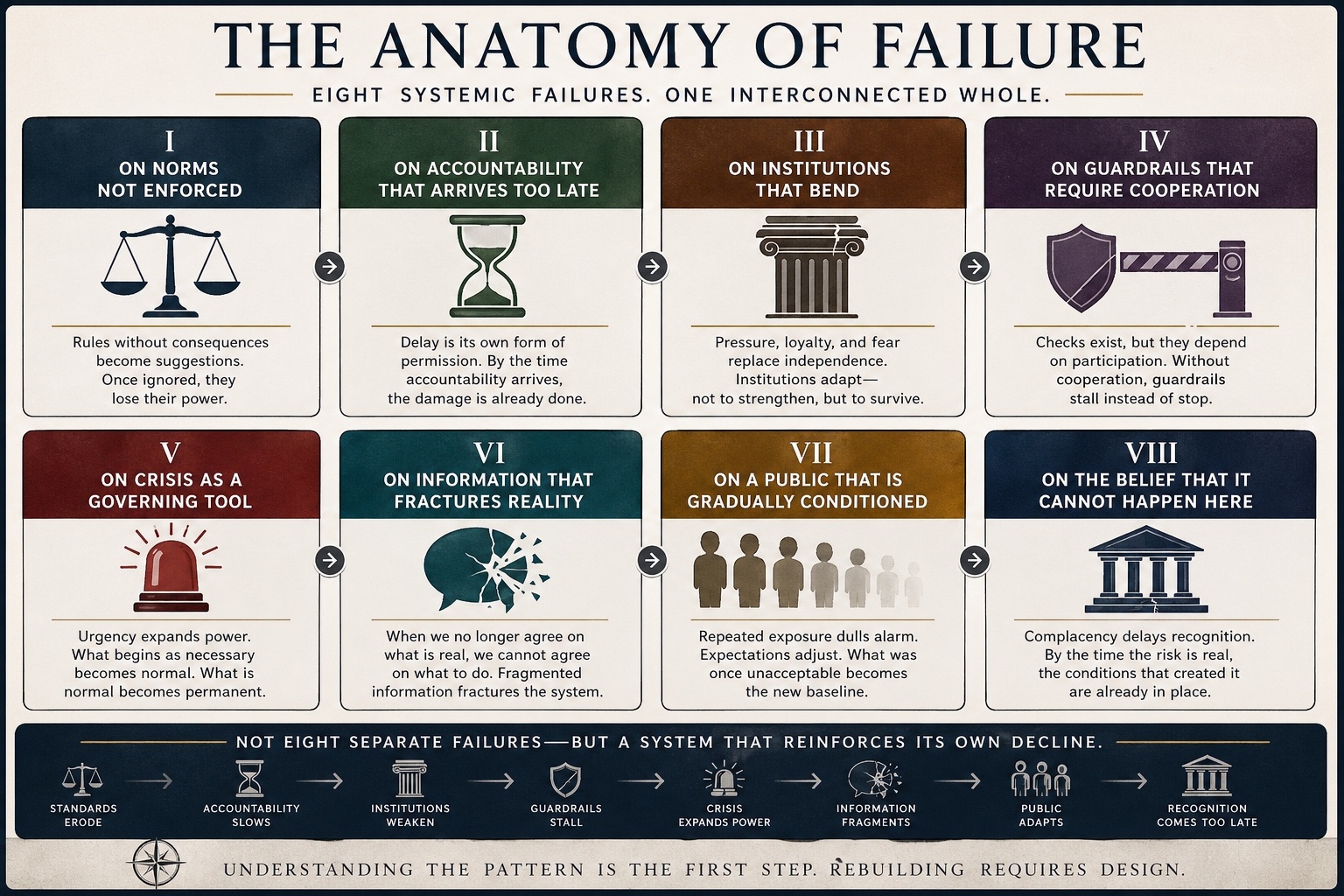
On the Belief That It Cannot Happen Here
The Failure
The system has long operated under an assumption of inherent stability—an expectation that its structure, history, and institutional design are sufficient to withstand sustained pressure without fundamental breakdown.
This assumption is not formally stated, but it is embedded in discourse, education, and public understanding. It appears in the language used to describe institutions as enduring, in the confidence placed in constitutional design, and in the belief that certain outcomes are unlikely not because they are prevented, but because they are improbable.
The effect of this assumption is not the absence of concern, but the delay of it. Risks are recognized, but often interpreted as temporary deviations rather than indicators of structural vulnerability.
By the time patterns are identified as systemic rather than incidental, they are already established.
The Comfortable Story
The prevailing narrative emphasizes resilience. It points to the longevity of the system, its ability to adapt through previous periods of strain, and the presence of mechanisms designed to correct imbalance.
According to this view, the system has been tested before and has held. Its survival is presented as evidence of its strength, and its continuity as confirmation that it will continue to function under future stress.
This narrative provides reassurance. It frames concern as caution rather than urgency, and it allows current conditions to be interpreted within a broader arc of endurance.
It also relies on comparison—presenting current developments as less severe than past crises, or as variations of challenges already addressed.
What this account overlooks is that resilience in one context does not guarantee resilience in another, and that systems may adapt to past threats while remaining vulnerable to new forms of pressure.
The Uncomfortable Fact
Stability is not an inherent property of a system.
It is a maintained condition.
When stability is assumed rather than actively reinforced, it becomes a point of vulnerability. The belief that the system will hold can delay recognition of conditions under which it may not, and can reduce the urgency of response when early indicators appear.
This delay does not require denial. It can coexist with awareness, provided that awareness is framed as manageable, temporary, or unlikely to produce lasting change.
The result is a consistent underestimation of risk.
By the time risk is acknowledged as structural, the conditions producing it have already taken effect.
How It Works
The mechanism operates through interpretation and expectation.
Early signs of strain—conflicts that test boundaries, decisions that stretch authority, patterns that diverge from established norms—are observed, but often categorized as anomalies. They are treated as exceptions rather than indicators of a broader shift.
This categorization shapes response. If an event is considered isolated, it does not require systemic correction. If it is viewed as temporary, it does not demand immediate intervention.
As similar events recur, the framework for interpretation adjusts slowly. What was once considered anomalous becomes part of a pattern, but that pattern may still be understood as limited in scope or duration.
During this period, the system continues to operate without significant structural change.
Only when patterns become difficult to reconcile with prior expectations does interpretation shift more substantially. At that point, the system is no longer responding to isolated events, but to an accumulated condition.
The delay between initial observation and structural recognition allows the underlying dynamics to develop without interruption.
Who Enables It
The belief in inherent stability is reinforced across multiple domains.
- Political discourse often emphasizes continuity and strength, even in the face of strain
- Institutional actors may frame challenges as manageable to preserve confidence and legitimacy
- Media narratives frequently contextualize events within historical comparison, reducing perceived severity
- Educational frameworks highlight durability, sometimes without equal emphasis on contingency
- Public perception draws on these signals, reinforcing the expectation that the system will endure
These influences do not require coordination. They align around a shared orientation toward reassurance.
Reassurance, while stabilizing in the short term, can obscure the need for timely adjustment.
Who Pays the Price
The cost of delayed recognition is distributed across the system.
Institutions continue to operate under assumptions that no longer fully apply, limiting their ability to respond effectively to changing conditions. Public expectations remain anchored to prior understandings, creating a gap between perception and reality.
Individuals and communities experience the consequences of decisions made within this gap—policies implemented under evolving conditions, actions taken without immediate constraint, and outcomes shaped before their broader implications are fully understood.
At a systemic level, the cost is measured in lost time. Opportunities for early intervention pass without action, and the range of available responses narrows as conditions become more entrenched.
Why It Is Allowed
The persistence of this belief reflects both historical experience and functional necessity.
Confidence in the system supports participation and compliance. It provides a basis for collective action and reduces the likelihood of destabilizing reactions to perceived risk. For these reasons, narratives of stability are reinforced rather than challenged.
There is also a natural tendency to interpret current conditions through familiar frameworks. If the system has endured previous challenges, it is reasonable to expect that it will endure again.
The difficulty arises when this expectation is applied without sufficient attention to difference. Not all pressures are identical, and not all vulnerabilities are equally visible at early stages.
Challenging the assumption of stability carries its own cost. It can generate uncertainty, reduce confidence, and require action that may be politically or institutionally disruptive.
As a result, there is an incentive to maintain the assumption as long as possible.
What It Reveals
The belief that failure is unlikely can become a contributing factor in its emergence.
When stability is treated as a given, the effort required to maintain it is reduced. Attention shifts from prevention to reaction, and the system becomes more dependent on its ability to recover than on its capacity to resist.
This reveals a broader condition: that resilience is not simply a function of design, but of recognition and response. Systems that identify and address strain early are more likely to maintain their integrity. Systems that delay recognition reduce their margin for correction.
The assumption that failure cannot occur does not prevent it.
It changes how it is perceived.
This is not a system that is unaware.
It is a system that recognizes slowly.
And in that delay, conditions develop that are more difficult to reverse.