Feeds:
Posts
Comments

To the Citizen Who Still Searches for Signal Beneath the Noise,

Modern media performs an extraordinary service and an extraordinary disservice simultaneously. It has become both the nervous system of democracy and, at times, its most persistent fever.

To examine it honestly requires resisting the temptation to flatten the issue into simple villainy. The modern press is not wholly corrupt, nor wholly noble. It is an ecosystem shaped by technology, economics, political polarization, audience behavior, and institutional fear. Within it exist courageous investigative journalists risking careers to expose corruption—and beside them, algorithm-fed outrage machines breathlessly reporting on the fifth manufactured controversy of the afternoon because panic retains attention longer than policy ever will.

The distinction matters.

What Modern Media Still Does Well

The modern press remains capable of astonishing acts of accountability. Investigative journalism continues to uncover abuses of power, corporate misconduct, civil rights violations, environmental disasters, and political corruption that would otherwise remain hidden. In an era where governments and corporations possess immense informational power, the existence of independent journalism is still essential to democratic survival.

The speed of modern reporting also carries genuine public value. Citizens can learn about legislation, court rulings, disasters, elections, international conflicts, and public safety concerns in near real time. Marginalized voices that were historically excluded from traditional gatekeeping structures now possess platforms capable of reaching millions directly. Local recordings, eyewitness accounts, and independent reporting have repeatedly exposed official falsehoods that older media systems may have buried.

In theory, this should have strengthened democracy.

In many ways, it has.

But theory and practice increasingly diverge.

The Sensationalism Problem

Modern media no longer competes merely for credibility. It competes for attention.

And attention is governed by algorithms, advertising revenue, emotional engagement metrics, and an endless demand for immediacy. The result is a system that often rewards emotional provocation over civic importance.

A zoning bill affecting housing shortages may receive a fraction of the coverage devoted to a politician’s insult on social media. Complex discussions about healthcare infrastructure struggle to compete against outrage clips carefully designed to trigger tribal fury. International humanitarian crises vanish beneath celebrity scandals and manufactured culture wars because suffering is less profitable than conflict theater.

The incentives are now dangerously misaligned.

News organizations once depended primarily upon subscriptions and long-term public trust. Today, many depend upon clicks, shares, engagement time, and viral circulation. Under those conditions, repetition becomes strategy. Fear becomes branding. Outrage becomes a renewable resource harvested hourly.

Thus citizens encounter the same sensationalized political stories repeatedly—not necessarily because they are the most important stories, but because they are the most emotionally productive.

The public begins living inside a hall of mirrors where visibility is mistaken for significance.

The Erosion of Accountability

Perhaps the gravest consequence is the weakening of journalism’s role as an institutional watchdog.

A healthy press does not exist to flatter power, nor merely to oppose it reflexively. Its duty is scrutiny. Yet modern political media often drifts toward one of two failures:

1. Access Journalism

Some outlets soften coverage to preserve relationships with political figures, administrations, insiders, or corporate interests. Reporters become dependent upon access, leaks, interviews, and proximity. Criticism grows cautious. Language becomes sanitized. Public officials are discussed as personalities managing narratives rather than stewards accountable to citizens.

Power becomes normalized through familiarity.

2. Outrage Performance

Other outlets swing toward perpetual catastrophe framing, where every development is treated as civilization-ending spectacle. While this may appear adversarial, it often weakens public accountability as well. Constant escalation numbs audiences. Citizens become emotionally exhausted and eventually unable to distinguish genuine constitutional crises from routine partisan conflict.

When every alarm is treated as the final alarm, eventually the public stops evacuating the building.

What Benjamin Franklin Might Recognize

Franklin would likely recognize the commercial pressures immediately. Colonial newspapers were partisan and profit-driven in their own way. He would not faint dramatically onto a chaise lounge over bias.

What would likely disturb him is scale.

The founders feared concentrated political power. They did not fully anticipate concentrated informational power amplified by machines capable of manipulating human attention in real time.

Franklin believed public discourse should sharpen civic virtue and practical wisdom. Modern systems often reward immediacy, certainty, tribal loyalty, and emotional reaction instead. Citizens are encouraged not merely to disagree, but to inhabit entirely separate realities.

And once shared reality erodes, accountability becomes nearly impossible.

Because officials no longer need to defend truth consistently. They need only maintain audience loyalty.

The Public’s Role in the Problem

The public itself is not blameless.

Sensationalism survives because audiences reward it. Citizens routinely claim to desire substantive journalism while disproportionately consuming conflict, outrage, scandal, and affirmation of existing beliefs. Algorithms did not emerge independently from the sea like ancient curses. They evolved to maximize the behavior people already demonstrated.

Modern media often resembles a carnival mirror held between institutions and audiences, each distorting the other.

This creates a dangerous civic cycle:

  • Politicians perform outrage for coverage.
  • Media amplifies outrage for engagement.
  • Citizens consume outrage for stimulation.
  • Serious governance disappears beneath spectacle.
  • Public trust collapses further.
  • Outrage intensifies to compensate.

And so the machine feeds itself.

The Central Question

The greatest danger is not merely misinformation.

It is the gradual transformation of citizenship into spectatorship.

A republic cannot function if politics becomes indistinguishable from entertainment. Citizens are not meant to be passive audiences waiting for the next emotionally satisfying episode. Self-government requires patience, context, memory, discernment, and sustained attention to issues that are often complicated and unglamorous.

Road maintenance is less exciting than scandal.
Judicial ethics are less clickable than insults.
Regulatory policy rarely trends.

Yet civilizations are preserved or destroyed far more often by the quiet mechanics of governance than by theatrical moments designed for prime-time reaction.

And that, perhaps, is where Franklin’s deepest concern would rest:

Not that Americans argue loudly—
but that they are increasingly encouraged never to think deeply at all.

I remain, with purpose,

Prudence C. Wilder

The Failure

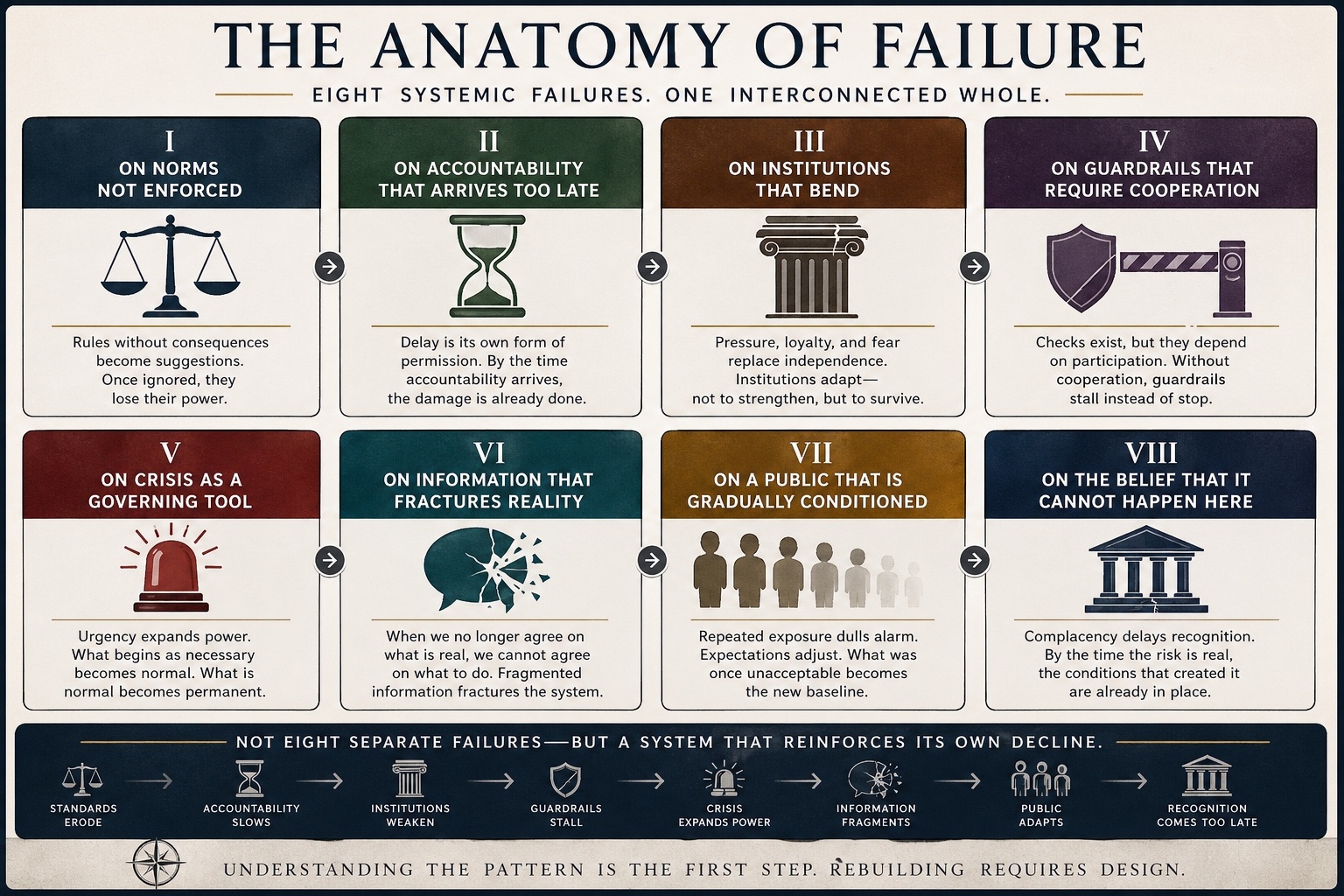
Institutions designed to operate with a degree of independence—legal, administrative, and regulatory—continue to function, but not always with the autonomy their structure presumes. Their authority remains intact in form, yet their behavior, in certain contexts, reflects accommodation rather than resistance when subjected to sustained pressure.

This shift is not typically declared. It does not require formal changes to law or structure. It occurs within existing frameworks, through adjustments in decision-making, prioritization, and internal interpretation. The institution remains recognizable, but its function is altered.

The result is not the removal of institutional checks.

It is their softening.

The Comfortable Story

The prevailing assumption is that institutions are inherently resilient. Their procedures, traditions, and internal norms are believed to provide sufficient insulation against external influence, particularly when that influence originates from political or personal interests.

According to this view, independence is self-sustaining. It is embedded in professional identity, reinforced by precedent, and protected by the expectation that those within the institution will uphold its standards regardless of circumstance.

This belief allows observers to take reassurance from continuity. If the institution remains in place—if its processes continue, its language remains consistent, and its personnel largely unchanged—then its independence is presumed to remain intact.

What this perspective overlooks is that independence is not simply a matter of structure.

It is a matter of behavior under pressure.

The Uncomfortable Fact

Institutions do not need to be dismantled to be weakened.

They need only to adjust.

Pressure rarely presents itself as a direct command to abandon standards. More often, it appears as a series of incentives and constraints:

  • Advancement tied to alignment
  • Risk attached to resistance
  • Ambiguity introduced where clarity once existed
  • Priorities reframed to favor certain outcomes over others

Under such conditions, overt defiance is not always required to produce compliance. The institution can continue to operate while gradually shifting its internal calculations—what is pursued, what is deferred, what is interpreted narrowly, and what is interpreted broadly.

The outward form remains.

The internal function changes.

How It Works

The process by which institutions yield to pressure is incremental and often difficult to isolate in a single moment.

It may begin with personnel changes—appointments or reassignments that alter leadership or influence key decision points. These changes do not, in themselves, constitute a breakdown. Institutions are designed to accommodate turnover. What matters is how those changes interact with existing expectations and pressures.

From there, shifts occur in priority:

  • Investigations may proceed more slowly or be narrowed in scope
  • Enforcement decisions may reflect altered thresholds for action
  • Legal interpretations may emphasize flexibility in areas that previously demanded constraint

These adjustments are often justified within the bounds of existing authority. They are framed as matters of judgment, resource allocation, or legal interpretation—categories that inherently allow discretion.

Over time, patterns emerge:

  • Certain actions are pursued more aggressively than others
  • Certain lines of inquiry are less likely to be followed to conclusion
  • Certain decisions align consistently with external interests, even when formally justified

None of these changes, taken individually, may appear sufficient to establish a loss of independence. Collectively, they alter the behavior of the institution in ways that are both observable and consequential.

Because the structure remains intact, the shift is difficult to contest in absolute terms.

It exists in accumulation.

Who Enables It

The yielding of institutions to pressure reflects the interaction of internal and external forces.

  • Executive leadership may exert influence through appointments, messaging, or the framing of institutional priorities
  • Institutional leadership may choose accommodation to preserve position, avoid conflict, or maintain operational continuity
  • Mid-level decision-makers may adjust behavior in anticipation of expectations, even in the absence of explicit instruction
  • Oversight bodies may recognize shifts but lack the immediacy or authority to intervene effectively
  • Political actors may reinforce alignment by rewarding cooperation and penalizing resistance

This process does not require coordination at every level. It operates through shared incentives and perceived risk.

When resistance carries cost and alignment carries benefit, behavior adjusts accordingly.

Who Pays the Price

The consequences of this shift are borne both within and beyond the institution.

Within the institution, individuals committed to maintaining standards may face isolation, stalled advancement, or pressure to conform. Over time, this can produce attrition, removing those most likely to resist and reinforcing the prevailing direction.

Beyond the institution, the impact is reflected in outcomes:

  • Enforcement that appears uneven
  • Decisions that align with influence rather than principle
  • Processes that produce results consistent with expectation rather than independent evaluation

For those subject to these decisions—whether individuals, organizations, or communities—the distinction between independent judgment and influenced outcome becomes increasingly difficult to discern.

At a broader level, the public encounters an institution that appears functional but behaves inconsistently. Confidence is not lost all at once. It is eroded through repeated instances in which expectation and outcome diverge.

Why It Is Allowed

The gradual nature of this shift makes it difficult to confront directly.

Because changes occur within the bounds of discretion, they can be defended as legitimate exercises of authority. Because the institution continues to operate, its legitimacy is not immediately questioned. Because each individual decision can be justified, the pattern they form is less readily challenged.

There is also a reluctance to intervene in institutional processes, particularly when those processes are designed to operate with independence. Oversight actors may hesitate to act in ways that could themselves be perceived as interference, creating a paradox in which independence is protected at the moment it is most vulnerable.

Additionally, the costs of confrontation are not evenly distributed. Those within the institution who resist may bear professional risk, while those outside may face political or reputational consequences for challenging institutional behavior.

In this environment, accommodation can present itself as stability.

Over time, it becomes the default response.

What It Reveals

Institutions are not self-protecting.

They rely on a combination of structure, culture, and behavior to maintain their independence. When any of these elements is altered under pressure, the institution may continue to exist without continuing to function as intended.

The central vulnerability lies in the gap between form and function. A system that appears intact may no longer operate with the independence it presumes, and that divergence may persist without formal acknowledgment.

This reveals a broader condition: that institutional integrity cannot be measured solely by structure or continuity. It must be assessed through behavior, particularly under conditions of pressure.

Where that behavior shifts, even subtly, the role of the institution changes.

This is not the collapse of institutions.

It is their accommodation.

And in that accommodation, their purpose is quietly redefined.

To the Citizen Who Expects Better,

A republic reveals itself not by how it treats the powerful, the popular, or the protected, but by how it treats those increasingly isolated by public fear, political opportunism, and cultural hostility.

This principle matters now more than many seem willing to admit.

Across the nation, there has emerged a growing appetite for division organized around identity — particularly surrounding transgender citizens, gay Americans, and increasingly, the broader rights and autonomy of women. What is most troubling is not merely the existence of disagreement within a democratic society. Disagreement is inevitable in a free republic. What is dangerous is the accelerating transformation of vulnerable groups into political instruments: symbols to be debated endlessly, feared publicly, legislated aggressively, and used strategically to inflame outrage, mobilize voters, and consolidate power.

A constitutional republic cannot remain healthy for long once entire categories of citizens become useful primarily as targets.

The Founders understood, perhaps better than modern political movements sometimes remember, that concentrated public fear is among the most dangerous forces in democratic life. Fear weakens restraint. Fear lowers standards. Fear encourages populations to tolerate expansions of state authority they would otherwise reject. Most importantly, fear teaches citizens to view one another not as participants in shared self-government, but as threats requiring containment.

This pattern repeats throughout history with exhausting consistency.

A population facing economic anxiety, institutional distrust, and civic exhaustion becomes especially vulnerable to scapegoating. Complex national problems are reduced into emotionally satisfying narratives involving “dangerous outsiders,” “moral decline,” “corrupting influences,” or citizens allegedly threatening the social order simply by existing openly within it.

And once politics becomes organized around the identification of internal enemies, constitutional principles begin eroding selectively.

Rights become conditional.
Liberty becomes negotiable.
Equality becomes partisan.
Human dignity becomes subject to polling.

This should alarm every citizen regardless of ideology.

Because the constitutional protections weakened against one group today rarely remain confined there permanently. A government comfortable intruding aggressively into bodily autonomy, private relationships, medical decisions, personal identity, educational access, or family life does not suddenly rediscover restraint once the original target loses political usefulness.

Power rarely expands itself temporarily.

The danger is not merely policy disagreement. The danger is the normalization of a political culture increasingly comfortable treating fellow citizens as abstractions rather than human beings carrying real vulnerability, fear, dignity, families, aspirations, and pain.

Women are not political property.
Gay citizens are not social contaminants.
Transgender Americans are not national scapegoats.

They are citizens.

And citizenship must mean something beyond conditional tolerance granted only when politically convenient.

A healthy republic requires enough civic maturity to distinguish between personal discomfort and public danger. Those are not the same thing, though modern politics increasingly profits from confusing them deliberately.

This nation already possesses serious crises demanding attention:

  • rising costs,
  • healthcare instability,
  • institutional distrust,
  • democratic erosion,
  • educational decline,
  • housing insecurity,
  • corruption,
  • political extremism,
  • and growing economic exhaustion.

A government increasingly obsessed with policing identity while these structural failures intensify reveals something important about its priorities.

Division is often easier than governance.

History offers repeated warnings about societies that redirected public frustration toward vulnerable minorities while deeper institutional problems remained unresolved beneath the surface. Such movements rarely strengthen nations. More often, they exhaust them morally while leaving underlying failures untouched.

And perhaps that is the greatest danger of all: not merely the harm inflicted upon targeted communities, but the gradual corrosion of the republic’s own civic character. A nation cannot normalize cruelty, suspicion, humiliation, and selective liberty indefinitely without those habits reshaping the culture itself.

The Constitution was not written to protect only the familiar, the comfortable, or the politically convenient. Rights possess meaning precisely because they constrain majorities during moments of emotional intensity, public anxiety, and cultural conflict.

That discipline is the test.

Not whether liberty protects people we already understand easily.
Whether it protects those whom society finds easiest to isolate.

Because once a republic grows comfortable deciding which citizens deserve diminished dignity, diminished autonomy, or diminished protection under law, the foundation beneath equal citizenship itself begins to weaken.

And foundations rarely collapse all at once.

More often, they erode gradually beneath the weight of fear citizens convinced themselves was patriotism.

I remain, in expectation,


Prudence C. Wilder

The Failure

Accountability within the current system does not operate in real time. It follows events rather than constraining them, often arriving only after decisions have been made, actions have taken effect, and consequences have been distributed.

Mechanisms for investigation, oversight, and review exist in abundance. Reports are written, hearings are held, findings are issued. Yet these processes are structured in such a way that they rarely interrupt behavior at the moment it occurs. Instead, they document it after the fact.

The result is a system in which the presence of accountability does not equate to its effectiveness. Consequence, when it arrives, does so on a timeline that is misaligned with the actions it is meant to address.

The Comfortable Story

The prevailing belief is that accountability, even if delayed, is sufficient. That thorough investigation requires time, that due process must not be rushed, and that eventual consequence—whether legal, political, or reputational—provides an adequate corrective.

This perspective emphasizes care over speed. It prioritizes completeness over immediacy. It assumes that the system’s ability to reach a conclusion, even if months or years later, preserves its integrity.

In practice, this narrative allows delay to be interpreted as diligence. Lengthy investigations are framed as necessary rigor. Procedural timelines are treated as evidence of fairness rather than potential sources of ineffectiveness.

The underlying assumption is that consequence retains its force regardless of when it is applied.

This assumption does not hold.

The Uncomfortable Fact

Accountability that arrives after the outcome has been secured does not function as a deterrent.

It functions as documentation.

When decisions can be made, implemented, and normalized before consequence is imposed, the system signals that timing matters more than legality, and that the benefits of action may outweigh the risks of eventual review.

In such a structure, delay is not neutral.

It is advantageous.

It allows:

  • Policy to take effect before scrutiny concludes
  • Narratives to solidify before findings are issued
  • Public attention to shift before consequences are applied

By the time accountability is delivered, the moment in which it could have prevented harm has passed.

How It Works

The failure unfolds through a consistent temporal sequence.

An action is taken that raises legitimate concern—whether involving the use of authority, the interpretation of law, or the alignment of public decision-making with private or political interest. The action is visible, but its status as a violation is contested or unclear.

Oversight is initiated. Investigations begin. Requests for information are issued. These processes, by design, proceed deliberately, often encountering procedural resistance, incomplete cooperation, or disputes over jurisdiction.

During this period, the action remains in effect.

Policies are implemented. Personnel decisions stand. Institutional direction adjusts to reflect the initial act. Public understanding begins to form around the new reality, often before the underlying conduct has been fully examined.

As time passes, the urgency of the initial concern diminishes. New developments arise. Attention shifts. What was once the central issue becomes one among many.

When findings are eventually produced—whether through formal reports, legal determinations, or institutional review—they arrive in a different context than the one in which the action occurred. The system has already moved forward.

Consequences, if imposed, are therefore applied to a moment that has already passed, rather than to a decision point that could still be influenced.

Who Enables It

The delayed nature of accountability reflects the interaction of multiple institutional behaviors.

  • Legislative bodies initiate oversight but operate within timelines shaped by procedure, negotiation, and political alignment, often slowing response when urgency is required
  • Investigative institutions pursue thoroughness, but are constrained by access to information, legal challenges, and resource limitations
  • Executive actors may delay cooperation, contest authority, or exploit procedural complexity to extend timelines
  • Judicial processes prioritize deliberation and precedent, inherently limiting the speed at which determinations can be made
  • Media environments highlight developments but are subject to cycles of attention that rarely sustain focus long enough to match the pace of formal accountability

Each of these roles operates according to its own logic. None is inherently defective. Together, they produce a system in which speed is consistently subordinated to process.

Who Pays the Price

The cost of delayed accountability is not confined to institutional inefficiency. It is borne by those affected during the period in which action proceeds without constraint.

Policies enacted under questionable conditions shape outcomes before their legitimacy is resolved. Decisions regarding enforcement, allocation, or prioritization take effect in real communities, with tangible consequences that cannot be fully reversed even if later deemed improper.

Public servants may be required to operate under directives that are subsequently challenged, placing them in positions where adherence to instruction conflicts with adherence to principle.

Citizens are asked to respond—politically, socially, or economically—to conditions that may later be reevaluated, but only after those conditions have already influenced behavior.

At a broader level, the public absorbs a more subtle cost: the erosion of confidence that accountability will occur in time to matter. Participation continues, but expectation adjusts.

Why It Is Allowed

Delayed accountability persists because the system prioritizes legitimacy of process over immediacy of response. This prioritization is not without justification. Thoroughness, fairness, and adherence to established procedure are essential to the credibility of any system of review.

The difficulty arises when these principles are applied without consideration of timing. A process that is fair but untimely may fail to prevent the very outcomes it is designed to address.

Actors within the system often face a choice between acting quickly with incomplete information or acting slowly with greater certainty. The system, as currently structured, favors the latter. This preference reduces the risk of error but increases the risk that action will occur without meaningful constraint.

There is also a structural incentive to delay. Immediate action carries political and institutional risk. Delay distributes responsibility, allows for recalibration, and reduces the likelihood that any single actor will bear the full cost of intervention.

Over time, delay becomes not an exception, but an expected feature of the system.

What It Reveals

The system is designed to determine what has happened.

It is less effective at preventing it from continuing.

This imbalance reflects a deeper orientation toward retrospective judgment rather than real-time constraint. Accountability is treated as an endpoint—a conclusion reached after sufficient evidence has been gathered—rather than as a mechanism that operates during the course of events.

The result is a system that is capable of producing detailed records of failure, but less capable of interrupting it as it unfolds.

Where timing is misaligned with action, consequence loses its preventive function. It may still serve a corrective or symbolic role, but it no longer shapes behavior at the moment when such shaping is most effective.

This is not the absence of accountability.

It is its displacement in time.

And in that displacement, its power is diminished.

To the Citizen Who Expects Better,

Citizens tighten their budgets while power decorates itself in gold.

There is something profoundly indecent about a government indulging in monuments, spectacle, and theatrical grandeur while ordinary Americans struggle simply to remain secure beneath rising costs, economic uncertainty, institutional exhaustion, and growing instability.

The Founders understood this instinctively. They had watched monarchs drape themselves in gold while common citizens carried the cost. They had seen palaces rise while civic institutions weakened. They understood that excessive displays of personal grandeur were not merely aesthetic choices, but political signals — visible declarations that the state exists increasingly to elevate the ruler rather than serve the public.

For this reason, the American presidency was intentionally designed with restraint in mind.

Not weakness.
Restraint.

The office was meant to project stability, seriousness, discipline, and constitutional continuity. Its legitimacy derived not from spectacle, ornament, or personal glorification, but from public trust and lawful limitation. The president was not intended to resemble a king, an emperor, or a gilded celebrity demanding architectural tribute to his own importance.

Yet increasingly, the public is confronted with precisely this impulse: the obsession with monuments to self, lavish embellishment, excessive personalization of public spaces, performative luxury, symbolic grandiosity, and the strange conviction that visible opulence reflects national strength.

It does not.

Gold plating does not strengthen a republic.
Massive ballrooms do not improve governance.
Personal monuments do not stabilize institutions.
Currency bearing the face of a living political figure does not elevate democracy.

These things serve vanity.

And vanity has always posed danger to constitutional government because vanity confuses personal image with national destiny. It encourages leaders to treat criticism as disloyalty, institutions as extensions of themselves, and public resources as instruments of personal legacy.

Benjamin Franklin understood the importance of civic humility perhaps better than most of his contemporaries. He cultivated usefulness rather than majesty. Practicality rather than spectacle. He recognized that republics survive not through theatrical displays of power, but through disciplined stewardship, functional institutions, informed citizens, and leaders capable of distinguishing public service from personal glorification.

That distinction now appears increasingly endangered.

There is something profoundly revealing about a government eager to invest symbolic energy into self-celebration while citizens struggle beneath rising costs, institutional distrust, political exhaustion, failing infrastructure, healthcare instability, educational conflict, and economic insecurity. The contrast is not merely poor taste. It reflects a distorted understanding of leadership itself.

Strong republics do not require rulers to decorate themselves like royalty.

In fact, the more fragile a leader’s legitimacy becomes, the more aggressively spectacle often expands to compensate for it. Grandeur becomes substitute for seriousness. Branding replaces statesmanship. Appearance overtakes substance.

History offers no shortage of examples.

And history is rarely kind to them.

This moment carries particular irony as the United States approaches its two hundred and fiftieth year. The nation preparing to celebrate its independence from monarchy now finds itself increasingly surrounded by the aesthetics of monarchy: gilded symbolism, personalized grandeur, loyalty-centered politics, public adoration rituals, and the elevation of individual image above institutional dignity.

The anniversary should invite reflection not merely on how long the republic has survived, but on what principles made it worth preserving in the first place.

This is not an argument against beauty, architecture, ceremony, or national symbolism. A nation should take pride in its public spaces. Civic beauty can elevate public life when it reflects shared ideals rather than individual ego.

But there is a meaningful difference between honoring a republic and ornamenting a personality.

The first strengthens citizenship.
The second weakens it.

And as the nation prepares to commemorate two and a half centuries since rejecting monarchy, Americans should ask themselves:

When leaders demand monuments to themselves while citizens struggle, what exactly are they governing for?

Because republics rarely abandon their principles all at once.

More often, they slowly redecorate themselves out of them.

I remain, unwilling to accept less,

Prudence C. Wilder

To the Citizen Who Expects Better,

There are conversations the public is permitted to have freely, and conversations it is quietly encouraged to avoid. Questions surrounding the health of national leadership increasingly belong to the second category—not because they lack importance, but because raising them risks immediate accusations of cruelty, impropriety, partisanship, or disrespect.

Yet the presidency is not an ordinary office, and a president’s condition is not merely a private matter once it bears upon public judgment, national stability, military authority, diplomatic negotiation, or the administration of law itself.

This distinction matters.

A republic depends upon informed citizens. Informed citizenship requires access not merely to comforting narratives, carefully staged appearances, or partisan reassurance, but to sufficient transparency for the public to assess whether those entrusted with extraordinary authority remain capable of exercising it responsibly.

This principle should not fluctuate according to party, personality, or preference. It should not matter whether the president in question is admired or despised, charismatic or abrasive, familiar or unsettling. Standards that apply only to political opponents are not standards. They are weapons disguised as principles.

Nor should legitimate inquiry be confused with mockery. There is a meaningful difference between cruel speculation and civic accountability. Democracies require the latter precisely because modern government concentrates enormous power in individuals whose decisions affect millions of lives, international stability, economic security, and, in moments of crisis, the potential use of military force.

History repeatedly demonstrates the danger of concealment surrounding leadership health. Information delayed for political convenience rarely remains contained indefinitely. When transparency is treated as optional, trust deteriorates accordingly. Citizens begin to suspect not merely the existence of undisclosed problems, but the existence of institutions more concerned with preserving political stability than public honesty.

That erosion of trust carries consequences far beyond any single administration.

The larger issue is not illness itself. Human beings age. Human beings decline. Human beings experience physical limitation, stress, exhaustion, and medical complication. No serious republic should demand impossible standards of perfection from its leaders.

What it must demand is candor.

Because a constitutional system cannot function properly when public confidence depends upon selective disclosure, managed appearances, or the expectation that citizens should ignore visible concerns for fear of appearing impolite.

A free people are not children to be managed emotionally. They are participants in self-government. And self-government requires enough truth to exercise judgment responsibly.

Questions are not threats to democracy.

A public discouraged from asking them is.

I remain, as ever,

Prudence C. Wilder


On Norms That Are Never Enforced

The Failure

The present structure of American governance continues to rely, to a significant degree, on expectations that have never been translated into enforceable requirements. These expectations—governing conflicts of interest, the appropriate use of public office, the integrity of public communication, and the basic discipline expected of those entrusted with authority—are widely understood, frequently invoked, and publicly defended, yet they remain largely uncodified or insufficiently enforced at the moments where enforcement is required.

This reliance reflects a long-standing assumption that formal law need not reach every boundary of conduct, because those who hold power will observe limits that are understood but not written. The system, in other words, presumes a level of internal restraint sufficient to compensate for what the law does not explicitly prohibit.

That presumption no longer functions as intended. It has not been formally repealed, nor publicly rejected, but it has been exposed as inadequate under conditions in which restraint is unevenly applied, selectively observed, or strategically ignored. The result is not the disappearance of standards, but their displacement by a different operating reality—one in which conduct once considered disqualifying persists without immediate consequence, and in which the absence of enforcement becomes more influential than the presence of expectation.

A system that relies on restraint without enforcing it does not prevent abuse.

It accommodates it.

The Comfortable Story

The persistence of this structure is sustained by a narrative that continues to reassure even as its underlying assumptions weaken. It is a narrative that emphasizes the durability of institutions, the corrective power of elections, and the belief that professional norms exert sufficient pressure to deter sustained misconduct. According to this view, the system possesses a self-regulating capacity: deviations may occur, but they will be corrected through exposure, public response, and eventual consequence.

This account draws credibility from earlier periods in which shared expectations were more consistently observed. Under those conditions, norms appeared to function as effective constraints, not because they were enforced, but because they were rarely challenged in ways that demanded enforcement.

What this narrative fails to account for is the conditional nature of that restraint. It assumes continuity where none is guaranteed, and it overestimates the restraining effect of reputational cost in an environment where reputational consequences can be absorbed, deflected, or neutralized through alignment, amplification, or repetition.

In practice, the reassuring story allows delay to present itself as prudence. Questions of conflict become matters for disclosure rather than disqualification. Misleading or demonstrably false public statements are cataloged, corrected, and then incorporated into ongoing communication without consequence. The use of public authority for personal or political advantage is acknowledged, debated, and reframed as interpretation rather than violation.

Each instance appears manageable in isolation.

Taken together, they produce a system in which recognition does not lead to correction, and where explanation increasingly substitutes for enforcement.

The Uncomfortable Fact

The system is not restrained by norms.

It is restrained by consequences.

Where consequences are absent, inconsistent, or delayed, norms lose their operational force. They remain part of the language of governance, invoked in hearings, reporting, and public statements, but they no longer determine behavior in real time.

The mechanisms often presumed to enforce norms—public criticism, investigative reporting, reputational damage—are indirect and contingent. They rely on sustained attention, shared interpretation, and a willingness to translate exposure into consequence. In the absence of those conditions, they function as documentation rather than deterrence.

This distinction becomes increasingly visible in a fragmented information environment. Conduct that once might have generated broad agreement regarding its impropriety is instead absorbed into competing narratives, where its meaning is contested rather than established. The absence of shared interpretation delays response, and delay diminishes the likelihood of meaningful enforcement.

Under these conditions, the boundary between what is improper and what is permissible does not disappear; it becomes negotiable. That negotiation benefits those willing to operate at its edge, as it shifts the burden from preventing the conduct to proving, after the fact, that it should not have occurred.

How It Works

The erosion of norms proceeds through a repeatable sequence rather than a single break.

Conduct first appears that extends beyond previously accepted limits—financial entanglements that remain disclosed but unresolved, interventions in administrative processes that blur the line between policy and personal advantage, public statements that depart from verifiable fact without producing structural consequence. These instances are identified, documented, and debated, but often lack a clear statutory mechanism for immediate response.

In the absence of immediate enforcement, the system moves into interpretation. Whether the conduct constitutes a violation becomes a matter of argument rather than application. During this period, the behavior continues to operate within the system, influencing decisions and outcomes.

If enforcement does not follow with clarity and speed, the initial instance establishes a reference point. Subsequent instances are measured against it, often with reduced urgency, because the first did not produce decisive consequence. What might once have been treated as disqualifying becomes, instead, one more example within an expanding range of tolerated conduct.

This process repeats across domains. Disclosed conflicts that do not result in recusal or divestment establish precedent for continued participation. Statements that are corrected without penalty establish a communication environment in which accuracy becomes conditional. Administrative actions that are criticized but not constrained signal that similar actions fall within an acceptable, if contested, range.

The system does not formally revise its rules.

It recalibrates around their inconsistent application.

Who Enables It

The persistence of this pattern reflects a distributed set of roles rather than a single point of failure. Those who exercise power may initiate or benefit from the erosion of norms, but its continuation depends on a broader ecosystem that identifies problems more reliably than it corrects them.

Legislative bodies possess the authority to define and enforce standards, yet may defer action in favor of political alignment, institutional caution, or strategic delay. Oversight mechanisms operate within procedural constraints that limit their ability to respond with speed, particularly when cooperation is partial or contested.

Media institutions document and expose conduct, but their ability to sustain consequence is constrained by the pace of events and the incentives of attention. Exposure does not guarantee enforcement, particularly when subsequent developments displace earlier ones or when competing narratives diffuse focus.

Financial and political networks frequently prioritize access and influence over structural integrity, reinforcing incentives to tolerate behavior that produces favorable outcomes. At the same time, segments of the public, confronted with constant controversy and contested information, may adjust expectations in response to fatigue, alignment, or a perceived lack of alternatives.

These roles are not coordinated in a formal sense. They do not require agreement.

They require only that no single actor imposes consequence with sufficient clarity to interrupt the pattern.

Who Pays the Price

The consequences of this failure are distributed across the system, but they are not evenly borne. Individuals subject to law and regulation encounter an environment in which enforcement appears inconsistent, creating uncertainty about both obligation and protection. Public servants may face pressure to align with directives that conflict with established standards, with limited assurance that adherence to those standards will be supported.

Communities affected by policy shaped under conditions of conflict or compromised judgment experience material consequences in the allocation of resources, the application of regulation, and the prioritization of enforcement. These effects accumulate gradually, often without a single identifiable cause, but with a common origin in the absence of consistent constraint.

At the level of civic culture, the cost is reflected in the erosion of expectation. When standards appear to shift in response to circumstance, confidence in their consistent application diminishes. This does not necessarily produce immediate disengagement; rather, it alters the terms of engagement. Participation continues, but with a reduced expectation that the system will respond predictably or equitably.

Over time, uncertainty becomes familiar.

And what is familiar is more easily accepted.

Why It Is Allowed

The continuation of this pattern reflects a series of decisions—often incremental, often justified—that favor delay over confrontation. Addressing violations in real time requires the acceptance of political risk, the willingness to incur institutional conflict, and the readiness to act under conditions of incomplete information.

Delay offers an alternative that appears more manageable. It distributes responsibility, reduces immediate tension, and allows actors to defer commitment. Processes are initiated, inquiries are announced, and statements are issued, creating the appearance of response while postponing its substance.

This approach is frequently framed as prudence, emphasizing the importance of due process and institutional stability. Each of these considerations is legitimate. Applied repeatedly in situations requiring timely intervention, however, they function less as safeguards and more as mechanisms of deferral.

Over time, delay ceases to be incidental and becomes structural. Behavior continues without interruption, consequences remain uncertain, and the system adjusts to their absence. What is permitted once becomes easier to permit again, not because it is accepted, but because it is not effectively prevented.

What It Reveals

The present condition reveals a central dependency within the system: its reliance on voluntary restraint as a substitute for enforceable limitation. Under conditions in which restraint is broadly shared, this dependency appears stable. When those conditions weaken, the dependency becomes a point of failure.

The lesson is not that norms lack value. Norms provide guidance, signal expectations, and shape institutional culture. They do not, on their own, constrain power where incentives favor expansion and consequences are uncertain.

Where enforcement is absent, expectations adjust. Where expectations adjust, standards shift. And where standards shift without formal acknowledgment, the system retains its outward structure while altering its internal function.

This is not a sudden transformation. It is a gradual redefinition of what is considered acceptable, driven not by explicit change, but by the accumulation of unaddressed deviation.

The result is a system that continues to describe itself in one set of terms while operating in another.

This is not a collapse.

It is a condition.

And it persists so long as expectation remains unpaired with consequence.

To the Citizen Who Expects Better,

There is a particular kind of exhaustion settling over this country now — not the exhaustion of labor alone, but the exhaustion of witnessing. The exhaustion of watching outrage become routine. The exhaustion of hearing behavior once considered disqualifying defended daily by people who once claimed to value character, law, patriotism, restraint, or decency. The exhaustion of watching corruption explained away as strategy. Cruelty reframed as strength. Ignorance celebrated as authenticity. The exhaustion of watching institutions delay, defer, investigate, table, postpone, and politely endure behavior that would destroy the lives of ordinary citizens in a matter of days.

The public is tired.

Tired of protests that seem unheard.
Tired of scandals that produce no accountability.
Tired of lies that remain profitable.
Tired of political theater masquerading as leadership.
Tired of watching elected officials behave less like statesmen and more like rival influencers trapped in an endless performance cycle for cameras, donors, and algorithms.

And perhaps most dangerously of all: people are becoming tired of believing resistance matters.

This exhaustion is understandable. It is also politically useful.

An exhausted population is easier to govern. Easier to distract. Easier to divide. Easier to convince that nothing can improve and therefore nothing is worth attempting. The constant flood of outrage, crisis, spectacle, cruelty, scandal, and absurdity does not merely happen around the public. It shapes the public. It overwhelms attention spans. It erodes civic stamina. It conditions citizens to expect disappointment and eventually mistake helplessness for realism.

But history offers an important warning: democracies rarely disappear all at once. More often, citizens simply grow too weary to defend them consistently.

This nation has endured periods of profound injustice before. Corruption before. Demagoguery before. Bigotry before. Lawlessness among the powerful before. The lesson of those eras is not that heroic figures appeared magically to save the republic while everyone else watched comfortably from the sidelines. The lesson is that ordinary citizens applied sustained pressure over time — politically, legally, economically, culturally, journalistically, morally, and electorally — until institutions were forced to move.

Not politely asked.

Forced.

Progress in this country has never emerged primarily from the goodwill of entrenched power. It emerged because pressure became impossible to ignore.

And that is where this moment now stands.

What has been done matters. Journalists have continued documenting abuses despite intimidation. Citizens have organized, protested, voted, litigated, educated, documented, and resisted disinformation. Whistleblowers, activists, scholars, workers, local organizers, independent media, attorneys, and ordinary exhausted people have kept pushing forward even while being told repeatedly that nothing changes.

But what is being done is still insufficient for the scale of the crisis.

Too many leaders continue treating democratic erosion as a public relations inconvenience rather than an institutional emergency. Too many officials speak passionately while acting timidly. Too many organizations fundraise endlessly off outrage while producing little structural change in return. Too many political actors remain more committed to preserving professional relationships, donor comfort, party stability, and personal career security than confronting the full seriousness of what is unfolding.

A republic cannot survive indefinitely on strongly worded statements and procedural decorum alone.

What should be done next is neither glamorous nor instantaneous. It is sustained civic pressure:

  • relentless documentation of abuses,
  • aggressive legal accountability,
  • local organizing,
  • labor organization,
  • voter participation,
  • independent journalism,
  • civic education,
  • institutional reform,
  • economic pressure where appropriate,
  • coalition building,
  • refusing normalization,
  • and refusing the seductive lie that exhaustion excuses surrender.

This does not require constant rage. Rage burns quickly. Discipline lasts longer.

That distinction matters.

The goal is not permanent outrage. The goal is sustained engagement. Democracies are not defended by emotional intensity alone. They are defended by stubborn persistence practiced repeatedly by ordinary people who refuse to quietly accept degradation as inevitable.

There will always be voices insisting resistance is pointless. There always have been. History remembers them poorly.

The republic does not require perfection from its citizens. It requires participation.

And participation becomes most important precisely at the moment exhaustion begins whispering:

“Nothing will ever change.”

That whisper is not wisdom.

It is surrender.

We are not finished.
Not unless we choose to be.

We must remain, unwilling to accept less,

— Prudence C. Wilder

To the Citizen Who Expects Better,

There are truths this nation prefers to discuss only in whispers, and racism is among them. We speak of it as though it lives solely in the past — in grainy photographs, burning crosses, segregated counters, and history books carefully closed after the final chapter. Yet racism did not vanish when laws changed. It adapted. It learned to wear suits instead of hoods. It learned to hide behind “policy,” “tradition,” “professionalism,” “electability,” “neighborhood character,” “school standards,” and “law and order.”

A system does not need openly declared hatred to produce unequal outcomes. It requires only a long enough tolerance for imbalance and a population willing to call injustice “normal” because it has become familiar.

We see it in politics that suppress participation while claiming to defend integrity. We see it in legal systems where wealth and race too often influence who is feared, who is believed, who is punished, and who is excused. We see it in schools where opportunity is distributed unevenly before a child has spoken their first ambitious dream aloud. We see it in workplaces where some must be twice as careful to receive half the grace. We see it in housing, healthcare, media coverage, environmental exposure, hiring practices, sentencing disparities, and in the quiet exhaustion carried by those forced to navigate these barriers daily while being told the barriers no longer exist.

And perhaps most dangerously, we see it in the instinctive defensiveness that emerges whenever these realities are named.

A society committed to justice does not fear examination. It welcomes it.

Calling out racism is not “division.” The division already exists. Naming it is the first act of repair. Silence protects systems precisely as they are. Silence allows inequity to become tradition. Silence teaches future generations to inherit prejudice disguised as procedure.

This work also demands honesty: racism is not corrected through slogans, symbolic gestures, or temporary outrage. It must be rooted out structurally. Laws must be examined. Institutions must be examined. Hiring practices, school funding formulas, policing strategies, sentencing structures, lending patterns, healthcare access, political rhetoric, and media incentives must all withstand scrutiny. If a system repeatedly produces unequal outcomes, then moral seriousness requires investigation rather than denial.

Some will object that this conversation is uncomfortable. They are correct. Accountability often is.

But discomfort is not oppression. Examination is not persecution. Equality does not threaten a just society; it strengthens one.

A nation cannot claim moral greatness while refusing to confront the machinery that diminishes its own citizens. Patriotism is not blind celebration of national myths. Patriotism is the courage to repair what is broken so the promises written into our founding ideals apply fully, honestly, and equally to everyone.

The work ahead is not about guilt inherited from the past. It is about responsibility in the present.

We are not obligated to preserve the failures of previous generations simply because we inherited them.

We are obligated to do better.

— Prudence C. Wilder

To the Citizen Who Expects Better,

There is a dangerous habit forming within modern public life: the lowering of standards until disgrace itself becomes routine.

A nation cannot remain serious if its leaders behave like quarrelsome children, nor can a republic survive long when elected officials reward vulgarity with applause, excuses, and obedience. The office does not become honorable simply because someone occupies it. Honor is carried into office by conduct, discipline, restraint, and respect for the weight of power.

Leadership is not performance art.

It is not endless insults shouted across microphones. It is not mocking opponents like schoolyard bullies. It is not rewarding loyalty over competence, nor surrounding oneself with flatterers who nod approvingly while institutions decay behind them. History is filled with governments that confused spectacle for strength shortly before collapse reminded them otherwise.

A mature society should expect maturity from those entrusted with authority. Not perfection. Not sainthood. But adulthood.

The President of the United States is not merely a private citizen with a larger audience. The office carries symbolic gravity. Every word spoken from it teaches the nation something about acceptable behavior. When cruelty becomes entertainment, dishonesty becomes strategy, and ignorance becomes a badge of pride, the damage spreads far beyond politics. It reaches schools, workplaces, families, and civic life itself.

Children learn by imitation. Nations do as well.

What is most alarming is not simply the conduct of a single leader, but the willingness of others to tolerate it for personal advantage. Too many officials now behave less like representatives of the people and more like courtiers in service to personality and power. They defend what they would once have condemned. They laugh when seriousness is required. They remain silent when courage is demanded.

A republic cannot function if dignity itself becomes partisan.

There was once an understanding that public office required a measure of restraint — that one should enter leadership prepared to rise above personal impulse rather than celebrate it. That expectation protected the nation more than many realize. Once abandoned, public life quickly descends into grievance, mockery, vanity, and spectacle.

And spectacle is easy.

Discipline is difficult.

Statesmanship is difficult.

Truthfulness is difficult.

But self-government was never meant to be easy. It was meant to require citizens mature enough to reject the constant temptation of outrage, ego, and theatrical nonsense.

We should stop applauding behavior we would punish in our own children.

We should stop treating shamelessness as authenticity.

We should stop rewarding public humiliation, impulsiveness, cruelty, and intellectual laziness simply because it arrives wrapped in partisan loyalty.

The standards we tolerate become the standards we inherit.

If the nation wishes to recover its footing, then citizens must once again demand seriousness from those who seek authority over them. Not because dignity is old-fashioned, but because civilizations cannot endure indefinitely without it.

I remain, unwilling to accept less.

Prudence C. Wilder