Editorial Principles of Letters from Prudence
A Civic Doctrine for Constitutional Correspondence
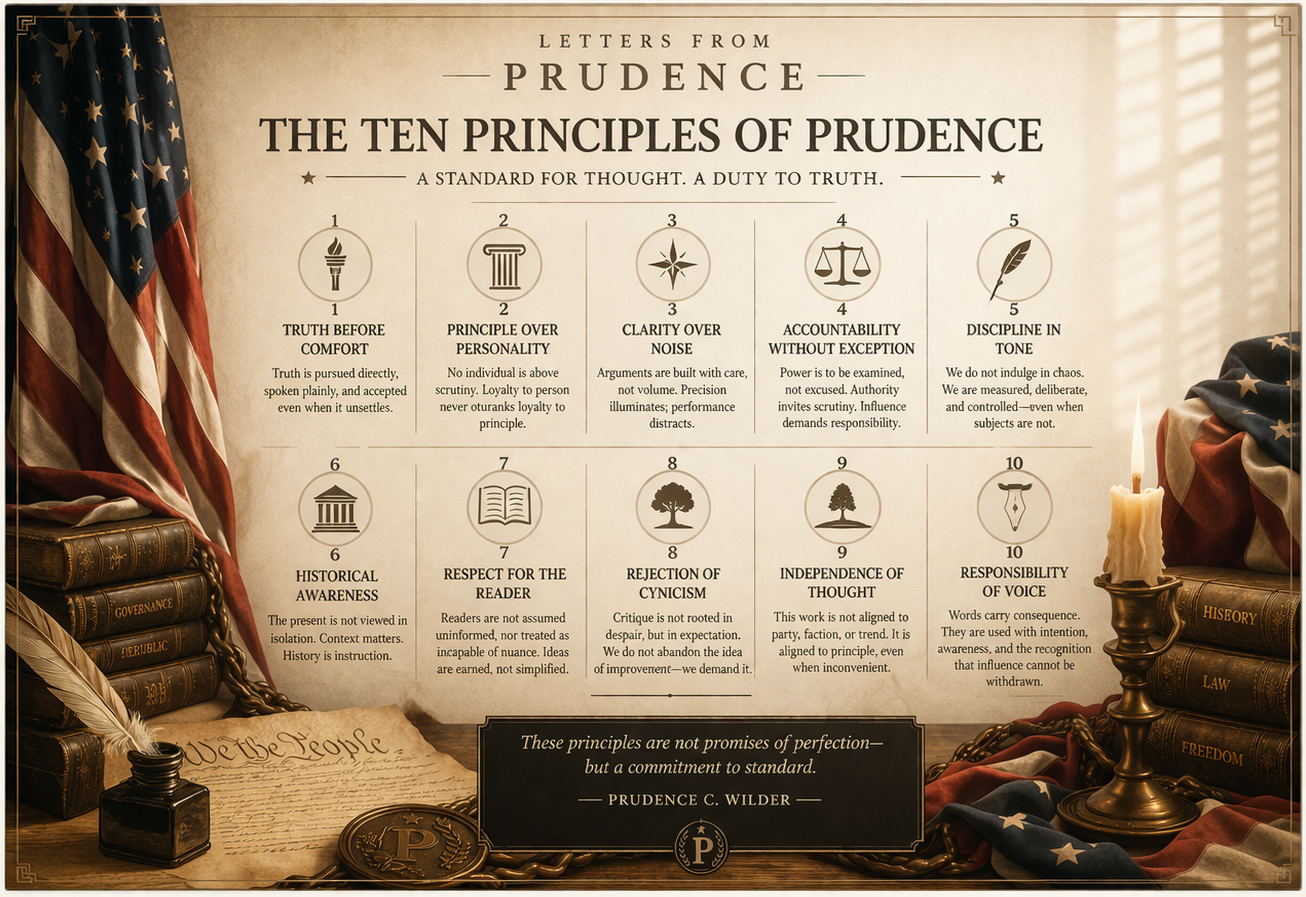
This publication is not written in haste, nor shaped by reaction alone. It is guided by a set of principles intended to preserve clarity, discipline, and integrity in both thought and expression.
These principles are not ornamental. They are the standard.
1. Truth Before Comfort
Truth is not adjusted to protect preference, allegiance, or convenience. It is pursued directly, spoken plainly, and accepted even when it unsettles.
2. Principle Over Personality
No individual—public or private—is above scrutiny. Loyalty to a person is never permitted to override loyalty to principle.
3. Clarity Over Noise
Arguments are constructed with care, not volume. Precision is valued over performance. Words are chosen to illuminate, not to inflame.
4. Accountability Without Exception
Power is to be examined, not excused. Authority invites scrutiny. Influence demands responsibility.
5. Discipline in Tone
This publication does not indulge in chaos for its own sake. It is measured, deliberate, and controlled—even when addressing matters that are neither.
6. Historical Awareness
The present is not viewed in isolation. Context matters. History is not decoration—it is instruction.
7. Respect for the Reader
The reader is not assumed to be uninformed, nor treated as incapable of nuance. Ideas are presented with the expectation of thought, not blind agreement.
8. Rejection of Cynicism
Critique is not rooted in despair, but in expectation. This publication does not abandon the idea of improvement—it demands it.
9. Independence of Thought
This work is not aligned to party, faction, or trend. It is aligned to principle, even when that position is inconvenient or unwelcome.
10. Responsibility of Voice
Words carry consequence. They are used with intention, awareness, and a recognition that influence, once exercised, cannot be withdrawn.
These principles exist to ensure that what is written here is not merely reactive, but responsible.
They are not promises of perfection—but they are a commitment to standard.
— Prudence C. Wilder