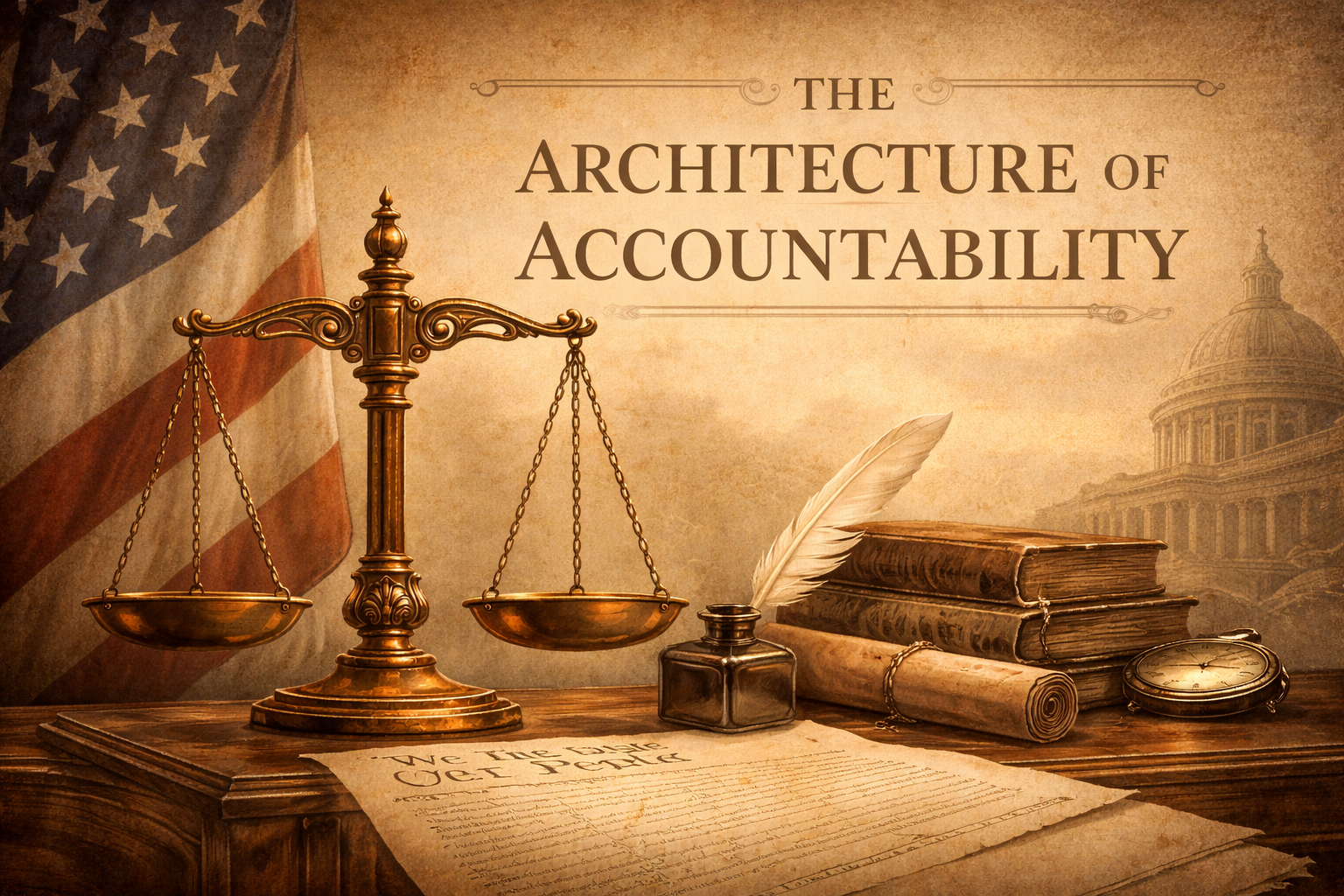
On Designing Guardrails for Bad Faith
The Architecture of Accountability defines the limits of power so the law applies equally — without exception for wealth, office, or influence.
Constitutions are not written for ideal leaders.
They are written for flawed ones.
The durability of a republic does not depend upon the character of those in office. It depends upon whether the structure restrains them when character fails.
Good faith governance requires few guardrails. Bad faith governance tests every one.
The central error of modern institutional design is this: too many safeguards assume cooperation. They presume that those exercising authority will respect norms, honor precedent, and act within unwritten boundaries.
Norms are valuable. They are not sufficient.
When norms erode, only structure remains.
History demonstrates that democratic backsliding rarely begins with open defiance of law. It begins with reinterpretation. Delay. Selective enforcement. Personnel replacement. Information restriction. Emergency expansion. Each step can be defended individually. Together, they alter the balance of power.
Consider the Weimar Republic. Article 48 of its constitution permitted emergency decrees intended for temporary crisis management. The mechanism was legal. The danger lay not in the existence of emergency authority, but in its repeated renewal and normalization. What was designed as exceptional became routine, and routine exception hollowed the system from within.
Closer to home, the expansion of executive authority following September 11 illustrates how emergency powers, once granted, rarely contract fully on their own. Many authorities justified under urgent necessity persisted long after immediate crisis subsided. The drift was not sudden collapse; it was gradual accretion.
Guardrails designed for good faith fail under these conditions.
Guardrails designed for bad faith must function automatically.
They must:
- Trigger without political will.
- Operate regardless of party alignment.
- Produce visible consequence.
- Disperse authority rather than concentrate it.
Emergency powers cannot rely upon voluntary restraint. Extraordinary authority must sunset unless affirmatively renewed under clear thresholds. What can be declared quickly must dissolve just as quickly.
Oversight mechanisms cannot depend upon personal courage. Inspectors General and watchdog bodies must be insulated from retaliatory removal and protected through transparent procedure.
Enforcement discretion must not be opaque. When prosecutorial power is broad, reporting standards must follow. When force is used, documentation must be mandatory. When high-profile cases are declined, justification must be articulated within lawful bounds.
Bad faith thrives in delay and ambiguity.
Architecture reduces both.
A republic cannot eliminate the possibility of misconduct. It can make misconduct harder to conceal, slower to consolidate, and easier to reverse.
No system guarantees perfect leadership.
But a well-designed system prevents imperfect leadership from becoming permanent control.
The test of constitutional resilience is not whether misconduct occurs.
It is whether structure corrects it.
Guardrails that depend upon goodwill are not guardrails.
They are hopes.
A durable republic builds constraints that function even when virtue does not.
That makes it meaningful.