I have noticed a peculiar American talent of late. We are remarkably skilled at detecting dishonesty in politicians we dislike and remarkably charitable when the same disease afflicts our own. Apparently falsehood, like beauty, now resides largely in the eye of the beholder. This might be merely amusing if we were arguing over baseball, but the consequences become considerably less entertaining when we are choosing the people entrusted with the powers of government.
Donald Trump provides us with an unusually useful study of the problem because his social-media habits leave so little to the imagination. A favorable event becomes proof of his success, while an unfavorable one is attributed to someone else’s failure. A complimentary report is credible; an unflattering one is suspect. Institutions, officials, journalists and judges may be praised when they confirm his account of events and attacked when they contradict it. After sufficient repetition, one begins to wonder whether reality itself has been expected to declare a party affiliation.
Yet, I am less interested in why Mr. Trump writes these things than in what happens when the rest of us read them. For that, psychology offers a useful little discomfort called cognitive dissonance. The term sounds considerably more exotic than the experience, which most of us have probably encountered before breakfast. It describes the discomfort we feel when two things we believe cannot easily live together, particularly when one threatens our judgment, identity, loyalty or understanding of ourselves.
Suppose I have supported a politician for years. I voted for him, defended him, repeated his arguments and perhaps endured more than one dreadful family dinner on his behalf. Then I encounter credible evidence that he has behaved in a way I would ordinarily condemn. I now have two uncomfortable facts occupying the same chair: I believe myself to be a sensible person who exercises good judgment, yet the person upon whom I exercised that judgment may not deserve my confidence.
I could reconsider my opinion, of course, but reconsideration is unpleasant business. I might have to admit that I was mistaken, perhaps publicly and possibly to someone who remembers with irritating precision how confidently I once informed her that she was wrong. The human mind, being wonderfully inventive when protecting its pride, therefore offers alternatives. The newspaper may be biased, the judge corrupt, the statistics manipulated, the recording taken out of context, the offending remark merely a joke, or the conduct excusable because everyone does it and the other fellow is worse. The uncomfortable evidence has been disposed of while the original belief remains safely on the shelf.
This does not make a person stupid. It makes a person human, and that distinction is important. Cognitive dissonance, confirmation bias and motivated reasoning do not belong exclusively to Republicans, Democrats, conservatives, progressives or whatever political tribe has lately invented a flattering name for itself. They belong to the species. The sensible citizen therefore does not merely ask how those people can believe something so obviously questionable. She asks the considerably less comfortable question of what she herself might be willing to believe—or excuse—because she very much wants it to be true.
Here we arrive at the more serious matter. When a political leader repeatedly teaches supporters that unfavorable information comes from dishonest journalists, corrupt officials, partisan judges, fraudulent elections, crooked opponents or compromised institutions, the effect can extend far beyond belief in any particular falsehood. The citizen’s very method of deciding what is true may begin to change.
The process is not difficult to understand. A leader makes a claim and credible evidence contradicts it. Rather than answer the evidence, the leader attacks its source. The supporter is then presented with a choice: reconsider the leader or distrust the source. Distrusting the source resolves the discomfort without requiring any reconsideration of the original loyalty, and the next time that source presents contradictory information, it begins with less credibility than before. Repeat the process often enough and contradiction itself may eventually be interpreted as evidence of persecution. A newspaper’s correction becomes proof that the newspaper is hostile; an adverse judicial ruling becomes proof that the court is corrupt; an unfavorable election result becomes proof that the election was fraudulent.
This is a remarkably convenient arrangement for anyone possessing power, because the ordinary means by which error and misconduct are exposed have been converted into further evidence that the powerful person was right all along. It is also poison to self-government.
Our constitutional system assumes that powerful people will occasionally behave badly. The framers were under no illusion that election to public office performed some miraculous improvement upon human character. They divided authority precisely because ambition, vanity, faction and self-interest were expected to arrive at government each morning along with everyone else. The structure they designed therefore depends not upon perfect leaders, but upon competing institutions, independent sources of authority and a citizenry capable of judging among them.
Those restraints become fragile when political loyalty determines which evidence citizens are willing to consider. A court can check a president only while citizens remain willing to accept that courts sometimes rule against presidents for legitimate reasons. A free press can expose misconduct only while inconvenient reporting is examined rather than automatically treated as treachery. Elections can settle political contests only while losing an election is still permitted to mean that one lost. Accountability itself becomes little more than decoration when every accusation against our preferred leader may be dismissed before we have troubled ourselves to discover whether it is true.
No constitutional amendment can rescue us from that habit, because the final remedy is irritatingly personal. We must learn to become suspicious of our own certainty. When someone we support is accused of wrongdoing, we ought to ask the same questions we would ask if the accusation concerned someone we despised: What is the evidence? Where did it originate? Can it be independently confirmed? Am I rejecting the claim because it is poorly supported, or because accepting it would make me uncomfortable? Most revealing of all, would I excuse precisely the same conduct if the politician belonged to the other party?
There is one question I would place above all the others: What evidence would cause me to change my mind? Every citizen ought to be capable of answering it. If the honest answer is nothing, then evidence no longer governs the belief; loyalty does. At that point we have ceased evaluating a public servant and begun protecting an allegiance.
That is a dangerous bargain in any republic because democratic citizenship requires something more difficult than possessing opinions. It requires retaining ownership of them. No politician is entitled to that ownership—not Donald Trump, not his opponents, not your party and not mine. Public officials may ask for our votes, our support and occasionally our patience, but none may reasonably demand that we distrust our own eyes whenever they observe something inconvenient.
There is no shame in discovering that we were wrong. Indeed, the ability to discover it may be among the quiet virtues upon which self-government depends. The greater embarrassment would be arranging the whole of reality so that we never have to.
When the Cure for Election Fraud Risks Becoming a Greater Threat Than the Disease
To the Citizen Who Expects Better,
There are few responsibilities government possesses more delicate than administering an election. The ballot is at once a remarkably modest thing—a mark on paper, a name on a roll, a sealed envelope—and one of the principal instruments by which the governed continue to give or withdraw their consent. A republic therefore has every legitimate interest in ensuring that ballots are cast only by those entitled to cast them.
But there is another obligation equally important and too often omitted from the conversation: government must ensure that its methods of preventing an unlawful vote do not prevent lawful ones.
That second obligation deserves particular attention now.
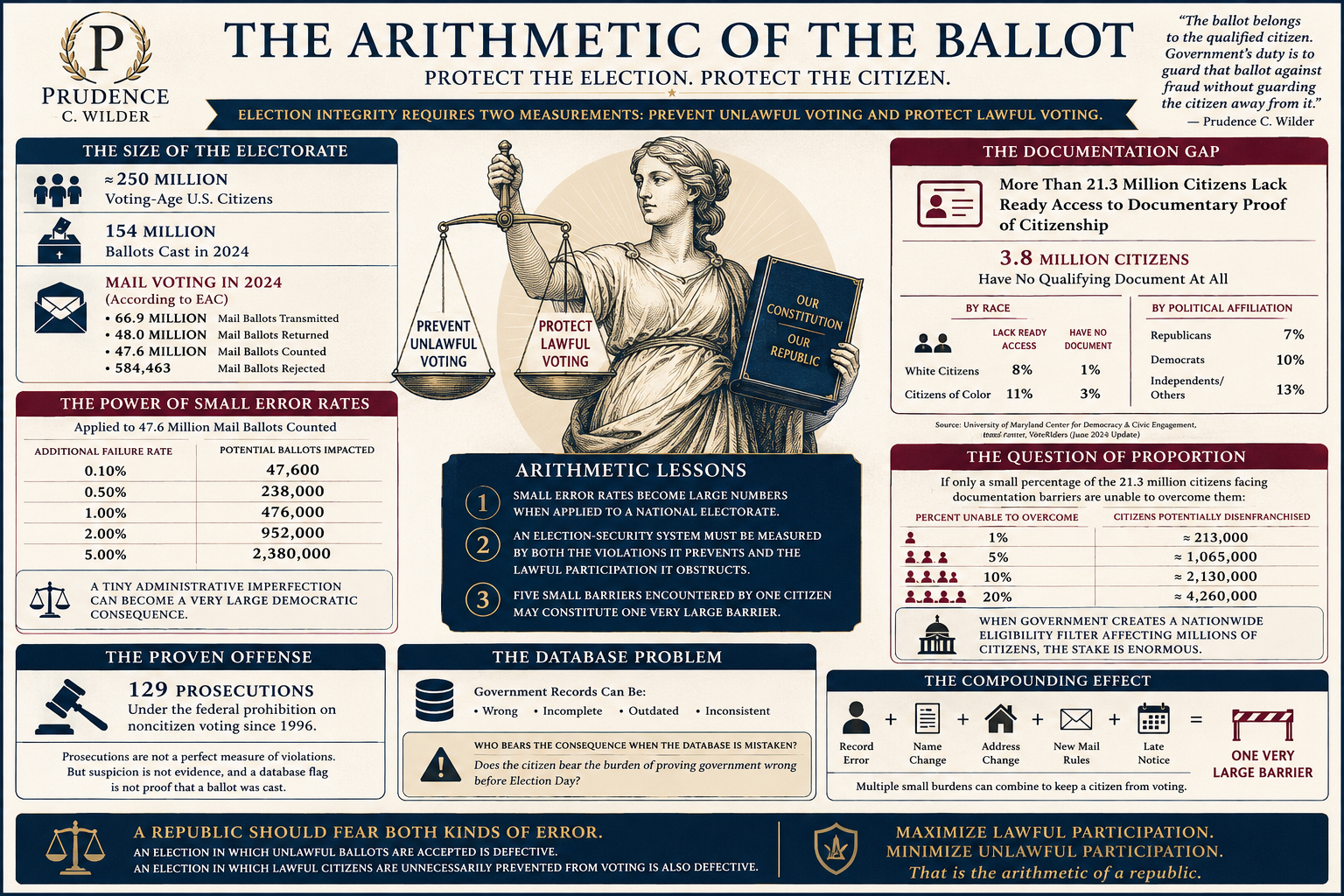
In March 2026, the President issued Executive Order 14399, directing the federal government to create a State Citizenship List for each state using records from the Department of Homeland Security, Social Security Administration, naturalization records, the SAVE database, and other federal sources. The order also directs changes to the handling and tracking of mailed ballots and provides for federal enforcement against violations of election law. The administration describes these measures as necessary protections against unlawful voting.
The principle sounds unobjectionable: only eligible citizens should vote.
It is the arithmetic beneath that principle that demands examination.
Begin With the Size of the Electorate
The United States contains roughly a quarter-billion voting-age citizens. In the 2024 presidential election, approximately 154 million Americans cast ballots.
Nearly one-third of those voters used the mail.
According to the United States Election Assistance Commission, election offices transmitted approximately 66.9 million mail ballots in 2024. About 48 million were returned, 47.6 million were counted, and 584,463 were rejected.
Those numbers matter because changing an election system need not produce an enormous error rate to produce an enormous number of errors.
Consider 47.6 million mailed votes.
If a new administrative requirement caused an additional failure affecting only one-tenth of one percent of them, approximately 47,600 ballots would be implicated.
At one-half of one percent, the number would approach 238,000.
At one percent, approximately 476,000.
This is not a prediction that those ballots will be lost. It is an illustration of scale.
When tens of millions of citizens pass through a system, what appears to be a tiny administrative imperfection can become a very large democratic consequence.
That is Arithmetic Lesson Number One.
Small error rates become large numbers when applied to a national electorate.
Then Consider Documentary Citizenship
Separate from the executive order, proposals for federal documentary proof of citizenship requirements have continued to receive political support. Their purpose is again straightforward: require a person registering to vote to demonstrate citizenship through prescribed documents rather than simply attest to citizenship under penalty of law.
The relevant question is not whether Americans possess citizenship.
The relevant question is whether Americans possess the paperwork necessary to prove it in the manner government demands.
Those are not the same thing.
Research conducted through the University of Maryland’s Center for Democracy and Civic Engagement, in partnership with the Brennan Center and VoteRiders, estimated that more than 21.3 million voting-age American citizens—more than 9 percent—do not have ready access to documentary proof of citizenship.
Approximately 3.8 million citizens lack any qualifying documentary proof of citizenship at all, such as a birth certificate, passport, naturalization certificate, or certificate of citizenship.
Pause over those numbers.
Twenty-one million Americans are not twenty-one million noncitizens.
They are citizens.
Their difficulty is not nationality.
It is paperwork.
This distinction should govern the entire debate.
A citizen does not become less American because her birth certificate was lost fifty years ago. A naturalized citizen does not surrender the franchise because an electronic database contains an outdated field. A man born in a rural county does not possess fewer constitutional rights because replacing a seventy-year-old record requires money, transportation, correspondence, or time.
Documentation may be useful evidence of citizenship.
But documentation is not citizenship itself.
The Constitution recognizes people, not filing cabinets.
Who Encounters the Documentation Problem?
The problem is not evenly distributed.
The University of Maryland study estimated that approximately 8 percent of White citizens and 11 percent of citizens of color lack ready access to documentary proof of citizenship. It estimated that approximately 1 percent of White citizens and 3 percent of citizens of color possess no such document at all.
The study also found differences among political groups.
Approximately 7 percent of Republicans, 10 percent of Democrats, and 13 percent of independents or others lacked ready access to documentary proof of citizenship.
That deserves emphasis because our political habits tempt us toward an easier story.
These requirements would not inconvenience only Democrats.
They would not inconvenience only Republicans.
They would not inconvenience only immigrants, minorities, urban voters, rural voters, elderly voters, young voters, married women, or people of modest means.
They would reach into all of these populations in differing proportions.
Election administration is not a partisan abstraction.
It eventually becomes somebody’s grandmother standing at a government counter trying to explain why the name on a birth certificate from 1952 does not match the name printed on her driver’s license in 2026.
The Married-Woman Problem
One particularly instructive complication concerns names.
Millions of Americans possess birth certificates bearing a surname different from the one they use today. Marriage, divorce, adoption, remarriage and other perfectly ordinary events can create chains of documentation that must be reconstructed before one document can be connected confidently with another.
This affects women disproportionately because women have historically changed surnames following marriage far more frequently than men.
The citizen exists.
The citizenship exists.
The difficulty lies in establishing that Mary Smith on one document became Mary Jones on another and perhaps Mary Anderson twenty years thereafter.
Election law should be wary of mistaking an administrative discrepancy for a constitutional deficiency.
A republic should never allow a paperwork puzzle to masquerade as evidence that the citizen herself is questionable.
Now Compare the Burden With the Proven Offense
This is the comparison that ought to sit at the center of the national argument.
Federal law already prohibits noncitizens from voting in federal elections. The President’s own executive order cites several federal criminal statutes enforcing that prohibition.
The policy question is therefore not whether noncitizen voting should be prohibited.
It already is.
The question is how frequently that crime occurs and what additional restrictions are proportionate to preventing it.
A Reuters investigation examining federal prosecutions found 129 prosecutions under the federal prohibition on noncitizen voting since 1996. That number does not establish that precisely 129 unlawful votes occurred; prosecutions are not a perfect measure of violations. Unreported or undiscovered offenses may exist.
But neither may suspicion be transformed into millions merely because millions make a better political argument.
Recent federal and state efforts to identify unlawful registration have repeatedly demonstrated another important distinction: a database flag is not proof of an unlawful voter. Courts and election officials have questioned the reliability of some federal database matching used in these efforts, while the administration has continued to pursue greater access to state voter information.
There are at least four different categories which public discussion routinely muddles together:
A registration record that cannot immediately be verified.
A person suspected of being a noncitizen.
A confirmed noncitizen who has registered.
A confirmed noncitizen who actually casts a ballot.
They are not synonyms.
Counting the first as though it proves the fourth is not election integrity.
It is bad arithmetic.
The Question of Proportion
Now the ledger becomes uncomfortable.
On one side we have a legitimate governmental interest: preventing votes by people legally prohibited from participating.
On the other side we have approximately 21.3 million eligible citizens who may not readily possess the documentation necessary to satisfy certain proof-of-citizenship systems.
That does not mean 21.3 million people would be disfranchised.
It would be irresponsible to claim otherwise.
Many would locate their documents. Others would replace them. Election administrators could provide alternative procedures. Courts might invalidate particular requirements. States could establish cure systems. Voters could adapt.
But exposure to a barrier is itself measurable.
Suppose only one percent of those 21.3 million citizens ultimately failed to overcome a documentary obstacle.
That would represent approximately 213,000 citizens.
At five percent:
1.065 million.
At ten percent:
2.13 million.
At twenty percent:
4.26 million.
Again, these figures are scenarios—not forecasts.
Their purpose is to illuminate the mathematics of policy.
When government creates a nationwide eligibility filter affecting millions of citizens, the relevant standard cannot merely be whether the filter catches some unlawful registrations.
We must also ask how many lawful citizens it catches incorrectly.
That is Arithmetic Lesson Number Two.
An election-security system must be measured by both the violations it prevents and the lawful participation it obstructs.
A mousetrap that catches one mouse and twenty housecats is not improved because the mouse truly existed.
The Database Problem
Executive Order 14399 directs DHS, USCIS and the Social Security Administration to construct citizenship lists using several federal databases and provide them to state election officials at least sixty days before regularly scheduled federal elections. It also requires procedures allowing individuals to access and correct their records.
That correction provision is essential.
It is also an acknowledgment of something fundamental:
government records can be wrong.
They can be incomplete.
They can be outdated.
They can contain spelling discrepancies, old addresses, delayed naturalization updates, duplicate names, transposed digits and mismatched records.
Anyone who has ever attempted to correct an erroneous credit report, medical record, tax record or motor-vehicle record will understand that government databases are not tablets descended from the heavens.
They are databases.
They are built by humans.
Humans have been known to type poorly before lunch.
The constitutional concern arises not from using databases but from deciding who bears the consequence when the database is mistaken.
If government says, “Our records cannot confirm your citizenship,” does government bear the responsibility for establishing the truth?
Or does the citizen suddenly bear the burden of proving government wrong before Election Day?
That difference is enormous.
Mail Voting Multiplies the Stakes
The administration has also pursued significant changes to mail-ballot administration through the Postal Service, including requirements involving voter information, official election-mail envelopes and unique tracking barcodes. Litigation over those rules has continued throughout the summer, with courts considering questions of presidential authority, USPS authority, state election powers and the potential effects upon voters.
About 30 percent of the electorate voted by mail in 2024.
That makes mail voting not some peculiar fringe practice but one of America’s principal methods of casting a ballot.
Millions of elderly Americans use it.
Military families use it.
Disabled Americans use it.
Rural Americans use it.
Working people use it.
Republicans use it.
Democrats use it.
Independents use it.
In several states, mail voting is woven deeply into the ordinary machinery of elections.
Administrative changes introduced shortly before an election therefore present a special danger even when those changes are defensible in theory.
Election systems reward stability.
A perfect rule introduced chaotically can produce worse results than an imperfect rule administered predictably.
Printers must be changed.
Software must be updated.
Voters must be instructed.
County officials must be trained.
Postal workers must know what constitutes compliant election mail.
Election offices must know how to respond when something goes wrong.
And voters must understand rules they may never previously have encountered.
Every additional junction is another place where error may enter the machinery.
The Compounding Effect
Perhaps the most overlooked danger is that these burdens do not always appear separately.
Imagine one perfectly eligible citizen.
Her federal citizenship record contains an error.
Her birth certificate carries her maiden name.
She has moved since her driver’s license was issued.
She ordinarily votes by mail.
Her county has recently changed its ballot-envelope procedures.
She receives a notice concerning her voter registration three weeks before Election Day.
No single item necessarily prevents her from voting.
She can make telephone calls.
She can obtain documents.
She can travel to an office.
She can correct records.
She can learn a new procedure.
She can perhaps vote in person.
But public policy should not assume that every citizen possesses unlimited money, transportation, mobility, internet access, free time and bureaucratic stamina.
The burdens compound.
And that gives us Arithmetic Lesson Number Three:
Five small barriers encountered by one citizen may constitute one very large barrier.
Election Integrity Requires Two Measurements
There is an understandable temptation to divide this debate into two tribes.
One says:
Protect the election from illegal voting.
The other says:
Protect voters from disfranchisement.
A competent republic must be capable of doing both.
Indeed, election integrity means both.
An election in which unlawful ballots are knowingly accepted is defective.
An election in which lawful citizens are unnecessarily prevented from voting is also defective.
The Constitution contains no provision declaring the second error more tolerable than the first.
The proper objective should therefore be extraordinarily simple:
Maximize lawful participation while minimizing unlawful participation.
That sentence should be capable of commanding agreement across nearly every political boundary in America.
The disagreement begins only when we ask whether a particular policy actually accomplishes it.
And that question should be answered with evidence.
The Questions Government Owes the Citizen
Before imposing any nationwide voter-verification system, Congress, the executive branch and state governments should publicly provide several measurements.
What is the demonstrated rate of noncitizen voting in federal elections?
Not suspected registrations.
Not database mismatches.
Not anecdotes.
Confirmed unlawful ballots.
What percentage of lawful citizens cannot initially satisfy the proposed documentation requirement?
What percentage successfully cure the deficiency?
How long does correction take?
How much does correction cost the citizen?
What percentage of citizenship-database matches are false positives?
What populations experience disproportionately high error rates?
How many lawful registrations are suspended, delayed or rejected?
How many lawful ballots are rejected?
How many unlawful ballots are actually prevented?
And perhaps most importantly:
What happens when government is wrong?
A constitutional right worthy of the name requires more than permission from an accurate database.
It requires meaningful protection from an inaccurate one.
A Republic Should Fear Both Kinds of Error
Election fraud deserves investigation wherever evidence establishes it.
Noncitizens who knowingly violate federal voting law should face the consequences prescribed by law.
Officials who knowingly manipulate election administration should likewise be held accountable.
But fear of fraud must not become a license for numerical imagination.
If the documented problem is small, government carries a heavier obligation to demonstrate why a sweeping remedy is necessary.
If the remedy affects tens of millions of citizens, government carries a heavier obligation to demonstrate that its error rate is exceptionally low.
And if government intends to place additional obstacles between citizens and the ballot, government carries the greatest obligation of all:
to ensure that lawful citizens do not become collateral damage in the pursuit of unlawful ones.
We do not protect democracy by trusting government less when counting votes and trusting government blindly when deciding who may cast them.
Both require scrutiny.
Both require evidence.
Both require transparency.
And both require the humility to admit that a citizen’s constitutional rights do not disappear merely because an algorithm, database, postal barcode, government clerk or political official has made a mistake.
The ballot belongs neither to the Republican Party nor the Democratic Party.
It does not belong to the President.
It does not belong to Congress.
It does not belong to the state.
It belongs to the qualified citizen.
Government’s duty is to guard that ballot against fraud without guarding the citizen away from it.
If the founders were alive to observe a republic in which power gathered itself around a single individual whose judgment was plainly a matter of public concern, their first response would not be surprise. It would be recognition.
They did not design the Constitution because they believed leaders would always be wise, virtuous, temperate, healthy, humble, or fit. They designed it because they knew leaders would often be none of these things. The Constitution is not a monument to human perfection. It is an instrument built in expectation of human frailty.
This is one of the great misunderstandings of American civic life. We often behave as though the republic depends upon electing better people, and while character certainly matters, the founders were not so naïve as to rest liberty upon character alone. They had seen kings, ministers, governors, legislatures, factions, creditors, speculators, mobs, and military men all reach for authority when opportunity allowed. Their answer was not to search forever for incorruptible rulers. Their answer was to divide power so that no person, office, faction, or branch could safely be trusted with too much of it.
James Madison gave this theory its most famous expression in Federalist No. 51, where he defended a constitutional structure in which branches of government possessed both the means and motives to resist one another. The National Constitution Center summarizes the design plainly: the framers divided power among legislative, executive, and judicial branches so that no single branch could become too powerful, while also giving each branch the power to check the others.
This was not inefficiency by accident. It was caution by design.
A republic that concentrates power for the sake of speed may discover, too late, that speed was never liberty’s highest virtue. Tyranny is often efficient. Arbitrary rule may move quickly. A single will, unrestrained by law, can act with terrifying clarity. The founders did not regard such decisiveness as a civic good when separated from accountability. They understood that free government must sometimes be slower than autocracy because liberty requires friction.
Franklin would have understood this deeply. He had lived under imperial authority, negotiated with power, criticized power, and watched officeholders mistake their convenience for the public interest. Franklin was practical enough to know that government was necessary and public institutions could do great good. He helped create libraries, civic associations, fire companies, and educational institutions. His suspicion was not of collective action. His suspicion was of authority that ceased to answer to the community it claimed to serve.
Franklin’s question would not be whether a particular leader possessed charm, confidence, popularity, or even a temporary mandate. He would ask whether the system retained the courage to restrain that leader when restraint became necessary. The danger, in his mind, would not be merely that an individual sought more power. Individuals have sought more power since Cain discovered envy. The danger would be that others, out of fear, ambition, convenience, or factional loyalty, allowed power to gather where the Constitution intended it to be divided.
Washington would likely view the matter through the lens of example. His most enduring act of leadership was not conquest but relinquishment. In 1783, after the Revolution, Washington resigned his military commission and returned to private life; later, after two presidential terms, he again stepped away, establishing a precedent that the presidency was not a lifetime possession. That act matters because Washington understood something many later politicians have forgotten: the health of a republic depends not only upon how power is acquired, but upon whether it can be surrendered. A political culture that treats one person as indispensable has already begun drifting away from republican government. No citizen, general, president, judge, senator, or party leader should become so central to public life that institutions lose the will to act without that person’s permission.
Adams, less sunny than Franklin and less revered than Washington, would perhaps be the most severe. He feared public passion, ignorance, vanity, and corruption because he knew republics could decay from within. He would likely ask whether citizens had become more devoted to personalities than to laws, more loyal to faction than to constitutional duty, and more willing to excuse incapacity in allies than danger in opponents. Such questions are uncomfortable, which is precisely why they are necessary.
The founders were not strangers to age, illness, ambition, vanity, or impaired judgment. They lived in a world where disease struck quickly, medicine was limited, and public men often served beyond the comfort of their bodies. Yet they did not confuse sympathy for frailty with surrender to it. Compassion may belong to the person; authority belongs to the office; responsibility belongs to the republic.
Modern America eventually recognized one weakness in the original constitutional design. The Twenty-Fifth Amendment, ratified in 1967, created procedures for presidential succession, vice-presidential vacancies, and presidential inability. It exists because the nation understood that continuity of government cannot depend upon rumor, loyalty, or denial when incapacity threatens the functioning of the executive branch. Yet a procedure written on parchment is not the same as a duty fulfilled in practice. The law may provide a mechanism, but citizens and officials must possess the courage to use lawful mechanisms when circumstances require them. No constitutional safeguard operates by magic. Every safeguard depends upon people who understand that their oath is not to comfort, career, party, or personal loyalty, but to the Constitution itself.
This is the heart of the matter. The founders would not be shocked that an ambitious or impaired individual might seek to retain power. They would be shocked if Congress forgot it was Congress, if courts forgot they were courts, if officers forgot their oaths, if parties became shields against accountability, and if citizens in the gallery mistook spectacle for self-government.
A republic is not endangered merely because one person reaches for more authority than wisdom permits. A republic is endangered when everyone else lowers their eyes.
The constitutional system assumes resistance. It assumes that ambition will answer ambition, that institutions will defend their own lawful authority, that citizens will notice encroachments, and that public servants will remember the difference between office and obedience. When those assumptions fail, the written Constitution remains, but the living habits that sustain it begin to weaken.
The founders would therefore ask us a sharper question than whether one leader is fit. They would ask whether the republic itself remains fit to restrain unfitness.
That is a harder question because it cannot be answered by medical opinion, election result, party platform, or personal dislike. It must be answered by examining whether the safeguards still function. Does Congress exercise oversight? Do courts enforce limits? Do officers honor lawful duties over personal loyalty? Do citizens demand truth? Do parties place country above advantage? Do institutions resist becoming instruments of one will?
If the answer is no, then the trouble is larger than any one individual.
The founders did not give us a system designed to survive only noble leaders. They gave us a system designed to survive ordinary human beings: proud, fearful, aging, ambitious, mistaken, exhausted, corruptible, and sometimes unwell. The Constitution’s genius lies not in assuming angels will govern us, but in recognizing that angels will not.
The crisis, then, is not human frailty. Human frailty was expected. The crisis is institutional surrender.
For when power forgets its limits, the republic depends upon those who remember theirs.
The constitutional system is constructed around a series of checks and balances intended to prevent the concentration and misuse of power. These checks exist across branches—legislative, executive, and judicial—and are designed to function as mutual constraints, ensuring that no single actor or institution operates without oversight.
In practice, however, many of these guardrails depend not only on formal authority, but on a baseline level of cooperation between the actors responsible for exercising that authority. The system presumes that when a check is triggered, it will be recognized, engaged, and allowed to function within a shared understanding of its legitimacy.
When that cooperation is absent, the guardrail does not disappear.
It stalls.
The Comfortable Story
The prevailing belief is that the separation of powers is sufficient in itself to prevent overreach. The existence of authority—Congress’s ability to oversee, the courts’ ability to review, agencies’ obligation to follow law—is treated as evidence that constraint is assured.
This belief rests on the idea that institutional roles carry inherent obligation. That when one branch exceeds its bounds, another will respond, not as a matter of preference, but as a matter of duty. That the system’s design compels action.
This understanding is reinforced by the visible presence of process. Hearings are convened. Subpoenas are issued. Cases are filed. Opinions are written. Each step appears to reflect a functioning check, reinforcing confidence that the system is operating as intended.
What this narrative obscures is that the exercise of these powers often requires participation, recognition, or compliance from the very actors being checked.
The Uncomfortable Fact
Many of the system’s guardrails are not self-executing.
They require cooperation to function effectively.
Subpoenas must be honored or enforced through additional process. Oversight depends on access to information that may be delayed, contested, or withheld. Judicial decisions, while authoritative, rely on compliance for implementation. Legislative remedies often depend on alignment sufficient to pass them.
When cooperation is replaced with resistance—procedural, political, or strategic—the guardrail does not activate in full.
It enters negotiation.
And in that negotiation, time is lost, clarity is reduced, and effectiveness is diminished.
How It Works
The failure emerges through the interaction between formal authority and practical limitation.
An action occurs that warrants oversight or review. A legislative body initiates inquiry, seeking documents, testimony, or explanation. Requests are issued, but responses are delayed, partially fulfilled, or contested on procedural or legal grounds. Enforcement of those requests requires additional steps—votes, litigation, negotiation—each extending the timeline.
Simultaneously, judicial processes may be invoked to resolve disputes over authority. These processes, by design, prioritize deliberation and precedent, further extending the period before a definitive outcome is reached.
During this time, the underlying action remains in effect.
Policies continue. Decisions stand. Institutional direction adjusts to reflect the initial act, even as its legitimacy is under review.
The same dynamic applies across branches. Oversight is initiated, but requires cooperation to be effective. Enforcement mechanisms exist, but are often indirect or dependent on additional actors. Each step in the process introduces opportunity for delay.
The guardrail is present.
It is not absent.
But it is not immediate, and it is not automatic.
Who Enables It
This condition is sustained by the interaction of multiple roles within the system.
Executive actors may resist oversight through delay, partial compliance, or legal challenge
Legislative bodies may be divided, reducing their capacity to act decisively or enforce their own authority
Judicial processes operate on timelines that prioritize thoroughness over immediacy
Institutional actors may defer to process even when delay undermines effectiveness
Political actors may frame resistance as legitimate defense rather than obstruction
None of these actions are necessarily outside the bounds of formal authority. Each can be justified within the language of law or procedure.
Together, they produce a system in which the exercise of checks becomes contingent rather than certain.
Who Pays the Price
The consequences of stalled guardrails are borne by those affected while the system negotiates its own authority.
Policies enacted under contested conditions remain in effect during prolonged review, shaping outcomes that may not be fully reversible. Decisions made without immediate constraint influence institutions, markets, and communities before their legality or propriety is resolved.
Public servants are required to operate within this uncertainty, implementing directives that may later be challenged, but are binding in the present.
Citizens encounter a system in which accountability appears procedural rather than practical. The existence of oversight is visible, but its impact is delayed, creating a gap between expectation and outcome.
Over time, this gap alters perception. The system appears active, but its ability to constrain power in real time is called into question.
Why It Is Allowed
The reliance on cooperation is not accidental. It reflects a design that balances power by distributing it, rather than concentrating enforcement in a single authority. This design assumes that each branch will act not only within its powers, but in recognition of the system as a whole.
When that assumption weakens, the system does not immediately replace it with a more forceful mechanism. Instead, it continues to operate through the same processes, even as those processes become less effective under conditions of resistance.
There is also a reluctance to escalate conflict between branches. Efforts to compel compliance—through enforcement actions, sanctions, or structural reform—carry political and institutional risk. As a result, actors may choose to proceed through extended process rather than immediate confrontation.
This approach preserves the appearance of order.
It does not ensure timely constraint.
What It Reveals
The system’s checks and balances are structurally sound in form, but conditionally effective in practice. Their effectiveness depends on a level of cooperation that is not guaranteed and, under certain conditions, is actively withdrawn.
This reveals a critical vulnerability: a system designed to prevent overreach assumes participation in its own constraints.
Where that participation is absent, the system does not fail outright. It slows, fragments, and defers.
The guardrails remain visible.
Their force is diminished.
This is not the absence of checks.
It is their dependence.
And where dependence replaces certainty, constraint becomes conditional.
Tomorrow marks two hundred and fifty years since a small collection of colonies declared before the world that liberty was not the property of kings, but the right of ordinary people. Two and a half centuries is an impressive birthday for a republic, and Americans may be forgiven a little cake, considerable noise, and enough fireworks to alarm every dog in the country.
We should celebrate.
We should also remember what we are celebrating.
Nations, like people, generally prefer stories in which they have behaved admirably from the beginning. History is less accommodating. The generation that declared that all men were created equal included men who enslaved other human beings. Women possessed few legal or political rights. Native peoples were displaced, excluded and subjected to policies entirely incompatible with the liberty being proclaimed. The government eventually created under the Constitution was remarkable, but neither the country nor the men who established it were perfect.
Acknowledging that does not diminish the founding principles. It demonstrates how powerful those principles became.
The words proved larger than the men who wrote them.
Generations of Americans who had been excluded from the original promise eventually took its language seriously enough to demand that the country do the same. Abolitionists challenged a nation that spoke of liberty while permitting slavery. Women demanded political standing in a republic that governed them without their votes. Civil-rights advocates insisted that equal protection mean something beyond ink on parchment. Workers, immigrants, disabled Americans, gay Americans and countless others have continued the same argument in different forms: if liberty and equality are American principles, then explain why they should stop at my door.
America’s progress has therefore seldom come from pretending that we had already perfected the republic. It has come from citizens noticing the distance between our principles and our practices and insisting that the distance be shortened.
That is a less comfortable national story than uncomplicated triumph, but I think it is a better one. A country capable of correcting itself has something more durable to celebrate than a country that merely congratulates itself.
There are presently those who speak as though America is hopelessly broken, and others who regard nearly any criticism of it as an insult. Neither position asks very much of the citizen. Despair relieves us of the responsibility to improve anything; nostalgia relieves us of the responsibility to notice what still requires improvement. Self-government permits neither luxury for long.
A republic is not an heirloom we place upon the mantel and admire because our ancestors left it there. It is an inheritance that arrives with maintenance instructions.
Those instructions are not terribly mysterious. Citizens must remain willing to distinguish truth from convenience, principle from party, public service from personal ambition, and disagreement from enmity. We must be capable of criticizing leaders we voted for and recognizing fairness in people we did not. We must preserve institutions when they frustrate us, because someday we may be exceedingly grateful that they can frustrate someone else.
Most of this work is rather ordinary.
The republic is present when an election worker carefully counts a ballot cast for a candidate she dislikes. It is present when a teacher gives a child the tools to question what adults confidently tell him. It is present when a journalist publishes an inconvenient fact, when a public servant refuses an improper order, and when neighbors who disagree about politics still help one another when the storm takes down a fence.
None of these things makes particularly impressive fireworks.
They are nevertheless closer to the substance of self-government.
Our predecessors in 1776 could not know what would become of the declaration they signed. They certainly could not have imagined all the people who would eventually claim its promises as their own. They left later Americans principles broad enough to expose their own contradictions, institutions capable of amendment, and an argument about liberty that subsequent generations have never quite stopped having.
Now the argument belongs to us.
Two hundred and fifty years is long enough to know that republics do not improve because improvement is inevitable. They improve because ordinary people refuse to accept the distance between what their country promises and what their country practices.
So tomorrow, celebrate loudly. Hang the flag. Attend the parade. Eat something cooked over a fire and watch the sky light up.
Then, when the smoke clears, remember that we inherited more than a birthday.
We inherited responsibility for what America becomes next.
To the Citizen Who Still Searches for Signal Beneath the Noise,
Modern media performs an extraordinary service and an extraordinary disservice simultaneously. It has become both the nervous system of democracy and, at times, its most persistent fever.
To examine it honestly requires resisting the temptation to flatten the issue into simple villainy. The modern press is not wholly corrupt, nor wholly noble. It is an ecosystem shaped by technology, economics, political polarization, audience behavior, and institutional fear. Within it exist courageous investigative journalists risking careers to expose corruption—and beside them, algorithm-fed outrage machines breathlessly reporting on the fifth manufactured controversy of the afternoon because panic retains attention longer than policy ever will.
The distinction matters.
What Modern Media Still Does Well
The modern press remains capable of astonishing acts of accountability. Investigative journalism continues to uncover abuses of power, corporate misconduct, civil rights violations, environmental disasters, and political corruption that would otherwise remain hidden. In an era where governments and corporations possess immense informational power, the existence of independent journalism is still essential to democratic survival.
The speed of modern reporting also carries genuine public value. Citizens can learn about legislation, court rulings, disasters, elections, international conflicts, and public safety concerns in near real time. Marginalized voices that were historically excluded from traditional gatekeeping structures now possess platforms capable of reaching millions directly. Local recordings, eyewitness accounts, and independent reporting have repeatedly exposed official falsehoods that older media systems may have buried.
In theory, this should have strengthened democracy.
In many ways, it has.
But theory and practice increasingly diverge.
The Sensationalism Problem
Modern media no longer competes merely for credibility. It competes for attention.
And attention is governed by algorithms, advertising revenue, emotional engagement metrics, and an endless demand for immediacy. The result is a system that often rewards emotional provocation over civic importance.
A zoning bill affecting housing shortages may receive a fraction of the coverage devoted to a politician’s insult on social media. Complex discussions about healthcare infrastructure struggle to compete against outrage clips carefully designed to trigger tribal fury. International humanitarian crises vanish beneath celebrity scandals and manufactured culture wars because suffering is less profitable than conflict theater.
The incentives are now dangerously misaligned.
News organizations once depended primarily upon subscriptions and long-term public trust. Today, many depend upon clicks, shares, engagement time, and viral circulation. Under those conditions, repetition becomes strategy. Fear becomes branding. Outrage becomes a renewable resource harvested hourly.
Thus citizens encounter the same sensationalized political stories repeatedly—not necessarily because they are the most important stories, but because they are the most emotionally productive.
The public begins living inside a hall of mirrors where visibility is mistaken for significance.
The Erosion of Accountability
Perhaps the gravest consequence is the weakening of journalism’s role as an institutional watchdog.
A healthy press does not exist to flatter power, nor merely to oppose it reflexively. Its duty is scrutiny. Yet modern political media often drifts toward one of two failures:
1. Access Journalism
Some outlets soften coverage to preserve relationships with political figures, administrations, insiders, or corporate interests. Reporters become dependent upon access, leaks, interviews, and proximity. Criticism grows cautious. Language becomes sanitized. Public officials are discussed as personalities managing narratives rather than stewards accountable to citizens.
Power becomes normalized through familiarity.
2. Outrage Performance
Other outlets swing toward perpetual catastrophe framing, where every development is treated as civilization-ending spectacle. While this may appear adversarial, it often weakens public accountability as well. Constant escalation numbs audiences. Citizens become emotionally exhausted and eventually unable to distinguish genuine constitutional crises from routine partisan conflict.
When every alarm is treated as the final alarm, eventually the public stops evacuating the building.
What Benjamin Franklin Might Recognize
Franklin would likely recognize the commercial pressures immediately. Colonial newspapers were partisan and profit-driven in their own way. He would not faint dramatically onto a chaise lounge over bias.
What would likely disturb him is scale.
The founders feared concentrated political power. They did not fully anticipate concentrated informational power amplified by machines capable of manipulating human attention in real time.
Franklin believed public discourse should sharpen civic virtue and practical wisdom. Modern systems often reward immediacy, certainty, tribal loyalty, and emotional reaction instead. Citizens are encouraged not merely to disagree, but to inhabit entirely separate realities.
And once shared reality erodes, accountability becomes nearly impossible.
Because officials no longer need to defend truth consistently. They need only maintain audience loyalty.
The Public’s Role in the Problem
The public itself is not blameless.
Sensationalism survives because audiences reward it. Citizens routinely claim to desire substantive journalism while disproportionately consuming conflict, outrage, scandal, and affirmation of existing beliefs. Algorithms did not emerge independently from the sea like ancient curses. They evolved to maximize the behavior people already demonstrated.
Modern media often resembles a carnival mirror held between institutions and audiences, each distorting the other.
This creates a dangerous civic cycle:
Politicians perform outrage for coverage.
Media amplifies outrage for engagement.
Citizens consume outrage for stimulation.
Serious governance disappears beneath spectacle.
Public trust collapses further.
Outrage intensifies to compensate.
And so the machine feeds itself.
The Central Question
The greatest danger is not merely misinformation.
It is the gradual transformation of citizenship into spectatorship.
A republic cannot function if politics becomes indistinguishable from entertainment. Citizens are not meant to be passive audiences waiting for the next emotionally satisfying episode. Self-government requires patience, context, memory, discernment, and sustained attention to issues that are often complicated and unglamorous.
Road maintenance is less exciting than scandal. Judicial ethics are less clickable than insults. Regulatory policy rarely trends.
Yet civilizations are preserved or destroyed far more often by the quiet mechanics of governance than by theatrical moments designed for prime-time reaction.
And that, perhaps, is where Franklin’s deepest concern would rest:
Not that Americans argue loudly— but that they are increasingly encouraged never to think deeply at all.
Citizens tighten their budgets while power decorates itself in gold.
There is something profoundly indecent about a government indulging in monuments, spectacle, and theatrical grandeur while ordinary Americans struggle simply to remain secure beneath rising costs, economic uncertainty, institutional exhaustion, and growing instability.
The Founders understood this instinctively. They had watched monarchs drape themselves in gold while common citizens carried the cost. They had seen palaces rise while civic institutions weakened. They understood that excessive displays of personal grandeur were not merely aesthetic choices, but political signals — visible declarations that the state exists increasingly to elevate the ruler rather than serve the public.
For this reason, the American presidency was intentionally designed with restraint in mind.
Not weakness. Restraint.
The office was meant to project stability, seriousness, discipline, and constitutional continuity. Its legitimacy derived not from spectacle, ornament, or personal glorification, but from public trust and lawful limitation. The president was not intended to resemble a king, an emperor, or a gilded celebrity demanding architectural tribute to his own importance.
Yet increasingly, the public is confronted with precisely this impulse: the obsession with monuments to self, lavish embellishment, excessive personalization of public spaces, performative luxury, symbolic grandiosity, and the strange conviction that visible opulence reflects national strength.
It does not.
Gold plating does not strengthen a republic. Massive ballrooms do not improve governance. Personal monuments do not stabilize institutions. Currency bearing the face of a living political figure does not elevate democracy.
These things serve vanity.
And vanity has always posed danger to constitutional government because vanity confuses personal image with national destiny. It encourages leaders to treat criticism as disloyalty, institutions as extensions of themselves, and public resources as instruments of personal legacy.
Benjamin Franklin understood the importance of civic humility perhaps better than most of his contemporaries. He cultivated usefulness rather than majesty. Practicality rather than spectacle. He recognized that republics survive not through theatrical displays of power, but through disciplined stewardship, functional institutions, informed citizens, and leaders capable of distinguishing public service from personal glorification.
That distinction now appears increasingly endangered.
There is something profoundly revealing about a government eager to invest symbolic energy into self-celebration while citizens struggle beneath rising costs, institutional distrust, political exhaustion, failing infrastructure, healthcare instability, educational conflict, and economic insecurity. The contrast is not merely poor taste. It reflects a distorted understanding of leadership itself.
Strong republics do not require rulers to decorate themselves like royalty.
In fact, the more fragile a leader’s legitimacy becomes, the more aggressively spectacle often expands to compensate for it. Grandeur becomes substitute for seriousness. Branding replaces statesmanship. Appearance overtakes substance.
History offers no shortage of examples.
And history is rarely kind to them.
This moment carries particular irony as the United States approaches its two hundred and fiftieth year. The nation preparing to celebrate its independence from monarchy now finds itself increasingly surrounded by the aesthetics of monarchy: gilded symbolism, personalized grandeur, loyalty-centered politics, public adoration rituals, and the elevation of individual image above institutional dignity.
The anniversary should invite reflection not merely on how long the republic has survived, but on what principles made it worth preserving in the first place.
This is not an argument against beauty, architecture, ceremony, or national symbolism. A nation should take pride in its public spaces. Civic beauty can elevate public life when it reflects shared ideals rather than individual ego.
But there is a meaningful difference between honoring a republic and ornamenting a personality.
The first strengthens citizenship. The second weakens it.
And as the nation prepares to commemorate two and a half centuries since rejecting monarchy, Americans should ask themselves:
When leaders demand monuments to themselves while citizens struggle, what exactly are they governing for?
Because republics rarely abandon their principles all at once.
More often, they slowly redecorate themselves out of them.
There are conversations the public is permitted to have freely, and conversations it is quietly encouraged to avoid. Questions surrounding the health of national leadership increasingly belong to the second category—not because they lack importance, but because raising them risks immediate accusations of cruelty, impropriety, partisanship, or disrespect.
Yet the presidency is not an ordinary office, and a president’s condition is not merely a private matter once it bears upon public judgment, national stability, military authority, diplomatic negotiation, or the administration of law itself.
This distinction matters.
A republic depends upon informed citizens. Informed citizenship requires access not merely to comforting narratives, carefully staged appearances, or partisan reassurance, but to sufficient transparency for the public to assess whether those entrusted with extraordinary authority remain capable of exercising it responsibly.
This principle should not fluctuate according to party, personality, or preference. It should not matter whether the president in question is admired or despised, charismatic or abrasive, familiar or unsettling. Standards that apply only to political opponents are not standards. They are weapons disguised as principles.
Nor should legitimate inquiry be confused with mockery. There is a meaningful difference between cruel speculation and civic accountability. Democracies require the latter precisely because modern government concentrates enormous power in individuals whose decisions affect millions of lives, international stability, economic security, and, in moments of crisis, the potential use of military force.
History repeatedly demonstrates the danger of concealment surrounding leadership health. Information delayed for political convenience rarely remains contained indefinitely. When transparency is treated as optional, trust deteriorates accordingly. Citizens begin to suspect not merely the existence of undisclosed problems, but the existence of institutions more concerned with preserving political stability than public honesty.
That erosion of trust carries consequences far beyond any single administration.
The larger issue is not illness itself. Human beings age. Human beings decline. Human beings experience physical limitation, stress, exhaustion, and medical complication. No serious republic should demand impossible standards of perfection from its leaders.
What it must demand is candor.
Because a constitutional system cannot function properly when public confidence depends upon selective disclosure, managed appearances, or the expectation that citizens should ignore visible concerns for fear of appearing impolite.
A free people are not children to be managed emotionally. They are participants in self-government. And self-government requires enough truth to exercise judgment responsibly.
There is a particular kind of exhaustion settling over this country now — not the exhaustion of labor alone, but the exhaustion of witnessing. The exhaustion of watching outrage become routine. The exhaustion of hearing behavior once considered disqualifying defended daily by people who once claimed to value character, law, patriotism, restraint, or decency. The exhaustion of watching corruption explained away as strategy. Cruelty reframed as strength. Ignorance celebrated as authenticity. The exhaustion of watching institutions delay, defer, investigate, table, postpone, and politely endure behavior that would destroy the lives of ordinary citizens in a matter of days.
The public is tired.
Tired of protests that seem unheard. Tired of scandals that produce no accountability. Tired of lies that remain profitable. Tired of political theater masquerading as leadership. Tired of watching elected officials behave less like statesmen and more like rival influencers trapped in an endless performance cycle for cameras, donors, and algorithms.
And perhaps most dangerously of all: people are becoming tired of believing resistance matters.
This exhaustion is understandable. It is also politically useful.
An exhausted population is easier to govern. Easier to distract. Easier to divide. Easier to convince that nothing can improve and therefore nothing is worth attempting. The constant flood of outrage, crisis, spectacle, cruelty, scandal, and absurdity does not merely happen around the public. It shapes the public. It overwhelms attention spans. It erodes civic stamina. It conditions citizens to expect disappointment and eventually mistake helplessness for realism.
But history offers an important warning: democracies rarely disappear all at once. More often, citizens simply grow too weary to defend them consistently.
This nation has endured periods of profound injustice before. Corruption before. Demagoguery before. Bigotry before. Lawlessness among the powerful before. The lesson of those eras is not that heroic figures appeared magically to save the republic while everyone else watched comfortably from the sidelines. The lesson is that ordinary citizens applied sustained pressure over time — politically, legally, economically, culturally, journalistically, morally, and electorally — until institutions were forced to move.
Not politely asked.
Forced.
Progress in this country has never emerged primarily from the goodwill of entrenched power. It emerged because pressure became impossible to ignore.
And that is where this moment now stands.
What has been done matters. Journalists have continued documenting abuses despite intimidation. Citizens have organized, protested, voted, litigated, educated, documented, and resisted disinformation. Whistleblowers, activists, scholars, workers, local organizers, independent media, attorneys, and ordinary exhausted people have kept pushing forward even while being told repeatedly that nothing changes.
But what is being done is still insufficient for the scale of the crisis.
Too many leaders continue treating democratic erosion as a public relations inconvenience rather than an institutional emergency. Too many officials speak passionately while acting timidly. Too many organizations fundraise endlessly off outrage while producing little structural change in return. Too many political actors remain more committed to preserving professional relationships, donor comfort, party stability, and personal career security than confronting the full seriousness of what is unfolding.
A republic cannot survive indefinitely on strongly worded statements and procedural decorum alone.
What should be done next is neither glamorous nor instantaneous. It is sustained civic pressure:
relentless documentation of abuses,
aggressive legal accountability,
local organizing,
labor organization,
voter participation,
independent journalism,
civic education,
institutional reform,
economic pressure where appropriate,
coalition building,
refusing normalization,
and refusing the seductive lie that exhaustion excuses surrender.
This does not require constant rage. Rage burns quickly. Discipline lasts longer.
That distinction matters.
The goal is not permanent outrage. The goal is sustained engagement. Democracies are not defended by emotional intensity alone. They are defended by stubborn persistence practiced repeatedly by ordinary people who refuse to quietly accept degradation as inevitable.
There will always be voices insisting resistance is pointless. There always have been. History remembers them poorly.
The republic does not require perfection from its citizens. It requires participation.
And participation becomes most important precisely at the moment exhaustion begins whispering:
There are truths this nation prefers to discuss only in whispers, and racism is among them. We speak of it as though it lives solely in the past — in grainy photographs, burning crosses, segregated counters, and history books carefully closed after the final chapter. Yet racism did not vanish when laws changed. It adapted. It learned to wear suits instead of hoods. It learned to hide behind “policy,” “tradition,” “professionalism,” “electability,” “neighborhood character,” “school standards,” and “law and order.”
A system does not need openly declared hatred to produce unequal outcomes. It requires only a long enough tolerance for imbalance and a population willing to call injustice “normal” because it has become familiar.
We see it in politics that suppress participation while claiming to defend integrity. We see it in legal systems where wealth and race too often influence who is feared, who is believed, who is punished, and who is excused. We see it in schools where opportunity is distributed unevenly before a child has spoken their first ambitious dream aloud. We see it in workplaces where some must be twice as careful to receive half the grace. We see it in housing, healthcare, media coverage, environmental exposure, hiring practices, sentencing disparities, and in the quiet exhaustion carried by those forced to navigate these barriers daily while being told the barriers no longer exist.
And perhaps most dangerously, we see it in the instinctive defensiveness that emerges whenever these realities are named.
A society committed to justice does not fear examination. It welcomes it.
Calling out racism is not “division.” The division already exists. Naming it is the first act of repair. Silence protects systems precisely as they are. Silence allows inequity to become tradition. Silence teaches future generations to inherit prejudice disguised as procedure.
This work also demands honesty: racism is not corrected through slogans, symbolic gestures, or temporary outrage. It must be rooted out structurally. Laws must be examined. Institutions must be examined. Hiring practices, school funding formulas, policing strategies, sentencing structures, lending patterns, healthcare access, political rhetoric, and media incentives must all withstand scrutiny. If a system repeatedly produces unequal outcomes, then moral seriousness requires investigation rather than denial.
Some will object that this conversation is uncomfortable. They are correct. Accountability often is.
But discomfort is not oppression. Examination is not persecution. Equality does not threaten a just society; it strengthens one.
A nation cannot claim moral greatness while refusing to confront the machinery that diminishes its own citizens. Patriotism is not blind celebration of national myths. Patriotism is the courage to repair what is broken so the promises written into our founding ideals apply fully, honestly, and equally to everyone.
The work ahead is not about guilt inherited from the past. It is about responsibility in the present.
We are not obligated to preserve the failures of previous generations simply because we inherited them.