When the Cure for Election Fraud Risks Becoming a Greater Threat Than the Disease
To the Citizen Who Expects Better,
There are few responsibilities government possesses more delicate than administering an election. The ballot is at once a remarkably modest thing—a mark on paper, a name on a roll, a sealed envelope—and one of the principal instruments by which the governed continue to give or withdraw their consent. A republic therefore has every legitimate interest in ensuring that ballots are cast only by those entitled to cast them.
But there is another obligation equally important and too often omitted from the conversation: government must ensure that its methods of preventing an unlawful vote do not prevent lawful ones.
That second obligation deserves particular attention now.
In March 2026, the President issued Executive Order 14399, directing the federal government to create a State Citizenship List for each state using records from the Department of Homeland Security, Social Security Administration, naturalization records, the SAVE database, and other federal sources. The order also directs changes to the handling and tracking of mailed ballots and provides for federal enforcement against violations of election law. The administration describes these measures as necessary protections against unlawful voting.
The principle sounds unobjectionable: only eligible citizens should vote.
It is the arithmetic beneath that principle that demands examination.
Begin With the Size of the Electorate
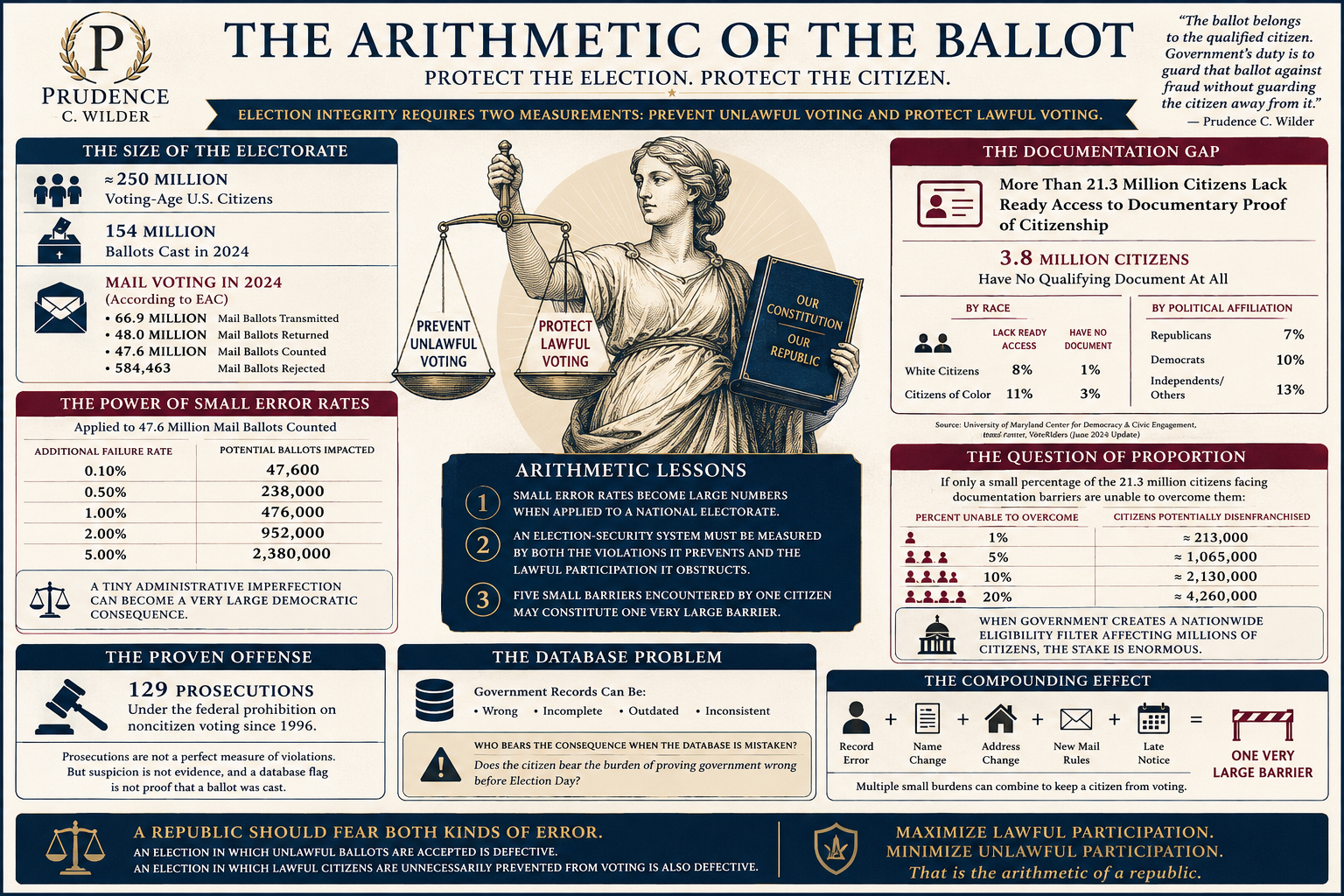
The United States contains roughly a quarter-billion voting-age citizens. In the 2024 presidential election, approximately 154 million Americans cast ballots.
Nearly one-third of those voters used the mail.
According to the United States Election Assistance Commission, election offices transmitted approximately 66.9 million mail ballots in 2024. About 48 million were returned, 47.6 million were counted, and 584,463 were rejected.
Those numbers matter because changing an election system need not produce an enormous error rate to produce an enormous number of errors.
Consider 47.6 million mailed votes.
If a new administrative requirement caused an additional failure affecting only one-tenth of one percent of them, approximately 47,600 ballots would be implicated.
At one-half of one percent, the number would approach 238,000.
At one percent, approximately 476,000.
This is not a prediction that those ballots will be lost. It is an illustration of scale.
When tens of millions of citizens pass through a system, what appears to be a tiny administrative imperfection can become a very large democratic consequence.
That is Arithmetic Lesson Number One.
Small error rates become large numbers when applied to a national electorate.
Then Consider Documentary Citizenship
Separate from the executive order, proposals for federal documentary proof of citizenship requirements have continued to receive political support. Their purpose is again straightforward: require a person registering to vote to demonstrate citizenship through prescribed documents rather than simply attest to citizenship under penalty of law.
The relevant question is not whether Americans possess citizenship.
The relevant question is whether Americans possess the paperwork necessary to prove it in the manner government demands.
Those are not the same thing.
Research conducted through the University of Maryland’s Center for Democracy and Civic Engagement, in partnership with the Brennan Center and VoteRiders, estimated that more than 21.3 million voting-age American citizens—more than 9 percent—do not have ready access to documentary proof of citizenship.
Approximately 3.8 million citizens lack any qualifying documentary proof of citizenship at all, such as a birth certificate, passport, naturalization certificate, or certificate of citizenship.
Pause over those numbers.
Twenty-one million Americans are not twenty-one million noncitizens.
They are citizens.
Their difficulty is not nationality.
It is paperwork.
This distinction should govern the entire debate.
A citizen does not become less American because her birth certificate was lost fifty years ago. A naturalized citizen does not surrender the franchise because an electronic database contains an outdated field. A man born in a rural county does not possess fewer constitutional rights because replacing a seventy-year-old record requires money, transportation, correspondence, or time.
Documentation may be useful evidence of citizenship.
But documentation is not citizenship itself.
The Constitution recognizes people, not filing cabinets.
Who Encounters the Documentation Problem?
The problem is not evenly distributed.
The University of Maryland study estimated that approximately 8 percent of White citizens and 11 percent of citizens of color lack ready access to documentary proof of citizenship. It estimated that approximately 1 percent of White citizens and 3 percent of citizens of color possess no such document at all.
The study also found differences among political groups.
Approximately 7 percent of Republicans, 10 percent of Democrats, and 13 percent of independents or others lacked ready access to documentary proof of citizenship.
That deserves emphasis because our political habits tempt us toward an easier story.
These requirements would not inconvenience only Democrats.
They would not inconvenience only Republicans.
They would not inconvenience only immigrants, minorities, urban voters, rural voters, elderly voters, young voters, married women, or people of modest means.
They would reach into all of these populations in differing proportions.
Election administration is not a partisan abstraction.
It eventually becomes somebody’s grandmother standing at a government counter trying to explain why the name on a birth certificate from 1952 does not match the name printed on her driver’s license in 2026.
The Married-Woman Problem
One particularly instructive complication concerns names.
Millions of Americans possess birth certificates bearing a surname different from the one they use today. Marriage, divorce, adoption, remarriage and other perfectly ordinary events can create chains of documentation that must be reconstructed before one document can be connected confidently with another.
This affects women disproportionately because women have historically changed surnames following marriage far more frequently than men.
The citizen exists.
The citizenship exists.
The difficulty lies in establishing that Mary Smith on one document became Mary Jones on another and perhaps Mary Anderson twenty years thereafter.
Election law should be wary of mistaking an administrative discrepancy for a constitutional deficiency.
A republic should never allow a paperwork puzzle to masquerade as evidence that the citizen herself is questionable.
Now Compare the Burden With the Proven Offense
This is the comparison that ought to sit at the center of the national argument.
Federal law already prohibits noncitizens from voting in federal elections. The President’s own executive order cites several federal criminal statutes enforcing that prohibition.
The policy question is therefore not whether noncitizen voting should be prohibited.
It already is.
The question is how frequently that crime occurs and what additional restrictions are proportionate to preventing it.
A Reuters investigation examining federal prosecutions found 129 prosecutions under the federal prohibition on noncitizen voting since 1996. That number does not establish that precisely 129 unlawful votes occurred; prosecutions are not a perfect measure of violations. Unreported or undiscovered offenses may exist.
But neither may suspicion be transformed into millions merely because millions make a better political argument.
Recent federal and state efforts to identify unlawful registration have repeatedly demonstrated another important distinction: a database flag is not proof of an unlawful voter. Courts and election officials have questioned the reliability of some federal database matching used in these efforts, while the administration has continued to pursue greater access to state voter information.
There are at least four different categories which public discussion routinely muddles together:
A registration record that cannot immediately be verified.
A person suspected of being a noncitizen.
A confirmed noncitizen who has registered.
A confirmed noncitizen who actually casts a ballot.
They are not synonyms.
Counting the first as though it proves the fourth is not election integrity.
It is bad arithmetic.
The Question of Proportion
Now the ledger becomes uncomfortable.
On one side we have a legitimate governmental interest: preventing votes by people legally prohibited from participating.
On the other side we have approximately 21.3 million eligible citizens who may not readily possess the documentation necessary to satisfy certain proof-of-citizenship systems.
That does not mean 21.3 million people would be disfranchised.
It would be irresponsible to claim otherwise.
Many would locate their documents. Others would replace them. Election administrators could provide alternative procedures. Courts might invalidate particular requirements. States could establish cure systems. Voters could adapt.
But exposure to a barrier is itself measurable.
Suppose only one percent of those 21.3 million citizens ultimately failed to overcome a documentary obstacle.
That would represent approximately 213,000 citizens.
At five percent:
1.065 million.
At ten percent:
2.13 million.
At twenty percent:
4.26 million.
Again, these figures are scenarios—not forecasts.
Their purpose is to illuminate the mathematics of policy.
When government creates a nationwide eligibility filter affecting millions of citizens, the relevant standard cannot merely be whether the filter catches some unlawful registrations.
We must also ask how many lawful citizens it catches incorrectly.
That is Arithmetic Lesson Number Two.
An election-security system must be measured by both the violations it prevents and the lawful participation it obstructs.
A mousetrap that catches one mouse and twenty housecats is not improved because the mouse truly existed.
The Database Problem
Executive Order 14399 directs DHS, USCIS and the Social Security Administration to construct citizenship lists using several federal databases and provide them to state election officials at least sixty days before regularly scheduled federal elections. It also requires procedures allowing individuals to access and correct their records.
That correction provision is essential.
It is also an acknowledgment of something fundamental:
government records can be wrong.
They can be incomplete.
They can be outdated.
They can contain spelling discrepancies, old addresses, delayed naturalization updates, duplicate names, transposed digits and mismatched records.
Anyone who has ever attempted to correct an erroneous credit report, medical record, tax record or motor-vehicle record will understand that government databases are not tablets descended from the heavens.
They are databases.
They are built by humans.
Humans have been known to type poorly before lunch.
The constitutional concern arises not from using databases but from deciding who bears the consequence when the database is mistaken.
If government says, “Our records cannot confirm your citizenship,” does government bear the responsibility for establishing the truth?
Or does the citizen suddenly bear the burden of proving government wrong before Election Day?
That difference is enormous.
Mail Voting Multiplies the Stakes
The administration has also pursued significant changes to mail-ballot administration through the Postal Service, including requirements involving voter information, official election-mail envelopes and unique tracking barcodes. Litigation over those rules has continued throughout the summer, with courts considering questions of presidential authority, USPS authority, state election powers and the potential effects upon voters.
About 30 percent of the electorate voted by mail in 2024.
That makes mail voting not some peculiar fringe practice but one of America’s principal methods of casting a ballot.
Millions of elderly Americans use it.
Military families use it.
Disabled Americans use it.
Rural Americans use it.
Working people use it.
Republicans use it.
Democrats use it.
Independents use it.
In several states, mail voting is woven deeply into the ordinary machinery of elections.
Administrative changes introduced shortly before an election therefore present a special danger even when those changes are defensible in theory.
Election systems reward stability.
A perfect rule introduced chaotically can produce worse results than an imperfect rule administered predictably.
Printers must be changed.
Software must be updated.
Voters must be instructed.
County officials must be trained.
Postal workers must know what constitutes compliant election mail.
Election offices must know how to respond when something goes wrong.
And voters must understand rules they may never previously have encountered.
Every additional junction is another place where error may enter the machinery.
The Compounding Effect
Perhaps the most overlooked danger is that these burdens do not always appear separately.
Imagine one perfectly eligible citizen.
Her federal citizenship record contains an error.
Her birth certificate carries her maiden name.
She has moved since her driver’s license was issued.
She ordinarily votes by mail.
Her county has recently changed its ballot-envelope procedures.
She receives a notice concerning her voter registration three weeks before Election Day.
No single item necessarily prevents her from voting.
She can make telephone calls.
She can obtain documents.
She can travel to an office.
She can correct records.
She can learn a new procedure.
She can perhaps vote in person.
But public policy should not assume that every citizen possesses unlimited money, transportation, mobility, internet access, free time and bureaucratic stamina.
The burdens compound.
And that gives us Arithmetic Lesson Number Three:
Five small barriers encountered by one citizen may constitute one very large barrier.
Election Integrity Requires Two Measurements
There is an understandable temptation to divide this debate into two tribes.
One says:
Protect the election from illegal voting.
The other says:
Protect voters from disfranchisement.
A competent republic must be capable of doing both.
Indeed, election integrity means both.
An election in which unlawful ballots are knowingly accepted is defective.
An election in which lawful citizens are unnecessarily prevented from voting is also defective.
The Constitution contains no provision declaring the second error more tolerable than the first.
The proper objective should therefore be extraordinarily simple:
Maximize lawful participation while minimizing unlawful participation.
That sentence should be capable of commanding agreement across nearly every political boundary in America.
The disagreement begins only when we ask whether a particular policy actually accomplishes it.
And that question should be answered with evidence.
The Questions Government Owes the Citizen
Before imposing any nationwide voter-verification system, Congress, the executive branch and state governments should publicly provide several measurements.
What is the demonstrated rate of noncitizen voting in federal elections?
Not suspected registrations.
Not database mismatches.
Not anecdotes.
Confirmed unlawful ballots.
What percentage of lawful citizens cannot initially satisfy the proposed documentation requirement?
What percentage successfully cure the deficiency?
How long does correction take?
How much does correction cost the citizen?
What percentage of citizenship-database matches are false positives?
What populations experience disproportionately high error rates?
How many lawful registrations are suspended, delayed or rejected?
How many lawful ballots are rejected?
How many unlawful ballots are actually prevented?
And perhaps most importantly:
What happens when government is wrong?
A constitutional right worthy of the name requires more than permission from an accurate database.
It requires meaningful protection from an inaccurate one.
A Republic Should Fear Both Kinds of Error
Election fraud deserves investigation wherever evidence establishes it.
Noncitizens who knowingly violate federal voting law should face the consequences prescribed by law.
Officials who knowingly manipulate election administration should likewise be held accountable.
But fear of fraud must not become a license for numerical imagination.
If the documented problem is small, government carries a heavier obligation to demonstrate why a sweeping remedy is necessary.
If the remedy affects tens of millions of citizens, government carries a heavier obligation to demonstrate that its error rate is exceptionally low.
And if government intends to place additional obstacles between citizens and the ballot, government carries the greatest obligation of all:
to ensure that lawful citizens do not become collateral damage in the pursuit of unlawful ones.
We do not protect democracy by trusting government less when counting votes and trusting government blindly when deciding who may cast them.
Both require scrutiny.
Both require evidence.
Both require transparency.
And both require the humility to admit that a citizen’s constitutional rights do not disappear merely because an algorithm, database, postal barcode, government clerk or political official has made a mistake.
The ballot belongs neither to the Republican Party nor the Democratic Party.
It does not belong to the President.
It does not belong to Congress.
It does not belong to the state.
It belongs to the qualified citizen.
Government’s duty is to guard that ballot against fraud without guarding the citizen away from it.
That is not a partisan proposition.
It is the arithmetic of a republic.
I remain, in expectation,
Prudence C. Wilder